

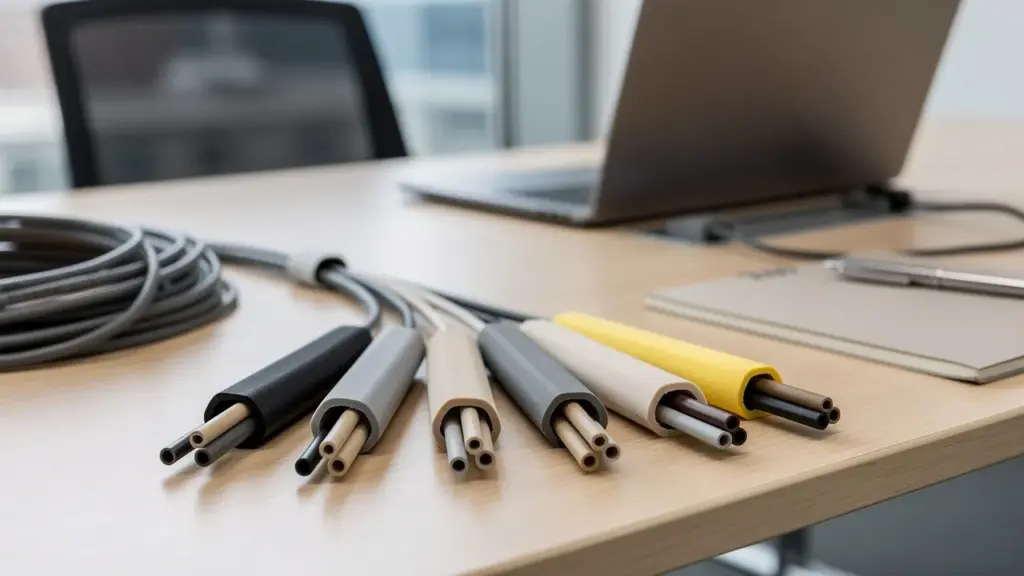
Screen the application before choosing the product type
Cable cord covers are sourced by matching the routing purpose and traffic environment to a defined profile; classify those conditions before asking for production pricing. A quote-ready record then adds dimensions, material, color, packaging, volume, and timing. Cable covers can organize and protect cords, route them along walls or floors, and help reduce trip hazards in pedestrian areas.
The installation environment sets the first sourcing boundary. Light-duty cable protectors are designed primarily for pedestrian traffic and indoor environments where heavy equipment is not present. They suit offices, retail spaces, and temporary setups without vehicle load requirements. If your product will encounter equipment traffic, record that condition separately; light-duty product descriptions apply to pedestrian environments without heavy equipment.
Record how the profile will route the cable before you select a construction. Include the number and approximate diameter of cables, whether cables enter through a slit or bottom opening, and whether the product must follow a straight or changing path.
Use four fields to screen the application: route, traffic, cable bundle, and installation format. Route identifies a wall or floor path; traffic identifies pedestrian use or equipment exposure; the bundle records cable count and approximate diameter; and the installation format identifies a slit, bottom opening, or sleeve. Record each field as a requirement rather than relying on a general product name.
Use existing product categories as comparison points, not as automatic specifications for your private-label line. A polyurethane protector is available in one- and two-channel systems for cables and hoses up to one inch in diameter and has a five-bar tread surface for improved traction. A separate sleeve is described as non-toxic, flame-retardant PET with a temperature range from -50°C to 150°C. Treat each description as a product-specific example and record the requirements for your own application.
Define the profile and dimensions for production
The cable-cover cross-section should be shown or dimensioned before a manufacturer evaluates production. Standard cord protectors are commonly long rubber or plastic strips with a flat bottom and domed top. They typically house three to five cords and are available in many colors and lengths. Your drawing should show the overall width and height, cable entry, wall thickness, channel count, corner features, and cut length.
A drop-over format uses cutout channels in the bottom so the cover fits over installed wires. The examples weigh roughly 3 to 9 pounds per 3-foot length, and double-sided tape can provide extra security. State whether your product will be installed over existing cables, placed before cable routing, or supplied as a flexible sleeve.
Heavy-duty plastic cord-cover examples can resist up to 21,000 pounds and are generally wider than light-duty protectors, allowing more cords and thicker cables. Do not transfer that load figure to your product record unless the responsible authority has established the requirement and test basis. Instead, identify the expected traffic, cable bundle, load condition, and any dimensional limit that the profile must meet.
Prepare a drawing package that separates the finished geometry from the commercial format. Include a dimensioned cross-section, overall width and height, channel openings, wall features, cut length, and the required tolerance for each functional dimension. Add a note showing how the cable enters and leaves the cover. If the profile will be coiled, cut, or supplied in fixed lengths, state that format beside the drawing.
A tape-based routing product is reported at prices starting around $16 for a 40-yard roll, which illustrates a different commercial format from an extruded channel. If tape is not your intended construction, exclude it from supplier comparisons. For an extruded cover, specify the finished length, coil or cut format, number of pieces per package, and the dimensions that must remain consistent from piece to piece.

Decide whether custom extrusion fits the project
Custom extrusion fits a distributor or private-label project when the product record requires a defined profile, production quantity, or presentation that an existing item does not provide. We provide plastic channel extrusion that allows OEMs to customize dimensions, colors, and materials for specific business needs. We can produce duct products in custom sizes and colors for distributors and brands. Put each requested variation in the RFQ instead of describing the project as simply “custom.”
Custom extrusion tubing can include custom designs, colors, and property characteristics. We provide custom extrusion that allows OEM purchasing managers to tailor materials and designs to their needs. Those options still need a defined production basis: show the cross-section, name the selected or supplier-recommended resin, identify the color target, and describe the application conditions. We then review the extrusion requirements and manufacturability.
Production volume belongs in the sourcing decision because custom extrusion provides scalability by allowing us to adapt production volumes. Give both annual volume and typical order quantity. Annual volume helps frame the program, while typical order quantity helps describe how the product will be released, packaged, and replenished. Include expected growth only as a planning assumption, not as a committed order.
Choose custom extrusion as the sourcing path when the required size, color, material, profile, or package needs to be defined for your product line. Keep a standard product comparison separate if you are still testing the market or comparing formats. For a private-label program, decide whether you need a new cross-section, a color or length variation, added packaging, or several of these together. That decision determines what belongs in the RFQ.
Use this short screen before you send the project record: the profile must be defined; the application must be identified; the material and color must be selected or under a stated resin-supplier recommendation; the package must be described; and the volume must justify a production program. If those fields are open, finish the internal product definition first. If they are set, custom extrusion is a reasonable sourcing route to evaluate.
Specify material, color, and product requirements
The material field should name the selected resin, grade, flexibility requirement, color system, and application conditions. We have traditionally worked with various durometers of flexible PVC base materials and similar flexible materials for specific customer applications. Common materials such as PVC, polyethylene, and polypropylene may be readily available, while specialty polymers or custom formulations can require additional sourcing time.
The plastic resin selected for an extrusion project can affect manufacturing timelines. Give us the material requirement or the resin supplier’s recommendation, along with any required additives, finish, flexibility, or color system. Keep those requirements separate from the application description so the quotation can distinguish a confirmed specification from a question that still needs technical review.
Color should be identified with a physical swatch, a Pantone reference, or another agreed color standard. Our colorant partners can match colors with the customer’s additive package and source colors to Pantone specifications. A finishing specification for one product requires a color swatch to be approved before production starts. Include the approval owner, reference, and required timing in your project record.
Separate required characteristics from preferred characteristics in the RFQ. Mark the resin, flexibility, color, finish, cable capacity, and environmental conditions as required only when your product definition depends on them. Put alternatives in a separate column with the reason for considering them. This gives the quotation review a clear order: fixed requirements first, acceptable options second, and unresolved selections last.
A product specification identifies its material as high-impact, flame-retardant thermoplastic and lists a depth of 5.59 mm (0.22 in), a height of 114.30 mm (4.50 in), and a width of 69.85 mm (2.75 in). Use that level of detail as a drafting model, not as a requirement for your product. Your drawing should identify which dimensions describe the finished profile and which material characteristics are mandatory.

Plan packaging and private-label presentation
The packaging requirement should describe how the distributor or private-label brand will receive, identify, and resell each unit. State the cut or coil length, pieces per package, package quantity, label content, barcode requirement, branding, and carton or pallet format. We individually package Flexiduct in 6-foot pre-split lengths, which gives you a concrete example of how a unit presentation can be defined.
We use a shrink-wrap machine for many Flexiduct packaging options. We may provide a post-extrusion shrink-wrap option depending on the product size. Tell us whether the requested package is intended for shelf presentation, distributor shipment, bulk handling, or a private-label kit. Include the desired package dimensions and any artwork or label files that must be accommodated.
Special handling belongs in the RFQ because extrusion alone may not describe the finished commercial product. We offer value-added services such as laser etching and specialized packaging. List any marking, identification, bundling, cut-to-length, or packaging operation as a separate line item. That structure helps you compare a quote for the finished resale unit rather than comparing only the extruded profile.
Complete these packaging fields before commercial review:
- Unit length, piece count, and package quantity.
- Brand name, label copy, barcode, and artwork responsibility.
- Protective packaging, shrink wrap, carton, and pallet requirements.
- Marking, etching, color identification, and lot or batch information.
- Shipping format, destination, and any special handling conditions.
If a field is undecided, mark it as an open commercial item instead of leaving it out.
Use volume and timing to frame the quotation
Annual volume and typical order quantity should appear as separate fields in the project record. Annual volume describes the expected program size; typical order quantity describes the release pattern. Add the first required delivery date, planned replenishment frequency, destination, and whether demand is seasonal. Those details give the manufacturer a commercial basis for reviewing the project rather than a single undated quantity.
Tie each quantity to a unit and a period. State whether annual volume is measured in pieces, feet, or packages, then give the expected quantity for each release. Add the first delivery requirement, recurring delivery pattern, destination, and packaging state. If the program has several colors or profile variations, show the volume for each variation instead of combining them into one total.
Profile complexity is one of the biggest factors influencing custom plastic extrusion lead times. Simple shapes with standard dimensions generally require less preparation than intricate profiles with tight tolerances or specialized performance requirements. Show cavities, thin walls, openings, variable thicknesses, and demanding dimensions on the drawing. A clear profile lets timing discussions reflect the actual part rather than a generic product category.
We provide custom plastic extrusion tubing for OEMs, including irrigation and cord-cover applications. For your project, identify the application, launch date, annual volume, typical order quantity, packaging state, and delivery location in one schedule. Separate tooling or setup activities from repeat production timing when those stages apply. Ask for the quotation basis and timing assumptions in the same commercial exchange.
Use market prices only as broad reference points
Market examples place a 5-foot standard cord protector at about $8 to $17. That range describes the stated standard product format, not a custom private-label extrusion. Use it only to understand the type of finished item being compared. Record your own length, material, channel count, color, packaging, and order quantity before treating any outside price as relevant.
Market examples report $30 to $73 per 3-foot length for drop-over protectors, depending on size, number of channels, and material durability. Those variables belong in your cost worksheet because they change the product being priced. A drop-over format, an adhesive-backed strip, and a flexible extruded channel should not be compared as though they were the same construction.
Market examples report heavy-duty cord-cover costs from $89 for a 27-by-5-inch strip to about $150 for a 36-by-17-inch strip. The same product category can resist up to 21,000 pounds and is generally wider to accept more cords and thicker cables than a light-duty protector. Keep the load condition, dimensions, and product format beside the price whenever you use this reference.
Build a cost worksheet with separate rows for the profile, resin, color, length, packaging, marking, and delivery format. Add annual volume and typical order quantity beside each requested variation. Keep market references in a separate column from your project assumptions. This prevents a retail product price from being mistaken for a custom production quote.
Material selection affects plastic-extrusion pricing because thermoplastic resins vary in cost based on their properties, availability, and performance characteristics. Profile complexity also affects manufacturing cost; simple shapes with consistent wall thicknesses are generally easier to produce than designs with multiple cavities, thin walls, or demanding dimensional tolerances. Give those variables to us with your drawing and volume so the project can be priced on its actual scope.
Build your internal estimate around the complete product, not a single market number. Include profile geometry, resin, color, cut length, packaging, marking, annual volume, typical order quantity, delivery destination, and any added operation. Treat outside prices as broad reference points. A project-specific commercial figure requires the defined product record.
Send the project record for a quote review
The completed cable-cover project record should contain the application, routing environment, profile drawing or dimensions, channel and cable requirements, selected material, color reference, packaging format, annual volume, typical order quantity, and timing. We provide custom flexible tubing for diverse applications and expert support and guidance in plastic channel extrusion for OEM purchasing managers. Put unresolved items in a separate list so they can be addressed without obscuring the defined requirements.
We provide tailored extrusion solutions for OEMs, including pipes, tubes, and flexible profiles. We also offer Flexiduct flexible cord-management solutions to manage cords and cables. Flexiduct is designed to organize and protect electrical cords in various environments. Use the project record to distinguish a requirement for Flexiduct from a request for a defined custom profile, color, package, or production format.
Before release, have the responsible technical or regulatory personnel confirm any application-specific electrical, installation, or compliance requirements. Then place the drawing, material, color, packaging, volume, order quantity, application, and timing details in one project file. A complete record gives us the information needed to review the manufacturing scope and commercial requirements.
Use the finished record as your next commercial handoff. Include the drawing or profile dimensions, application, material, color, packaging, annual volume, typical order quantity, delivery destination, and timing assumptions. The defined record lets you request a project-specific review without replacing open requirements with generic product terms.
Cable cord cover sourcing FAQs
Are light-duty cable cord covers suitable for vehicle or heavy-equipment traffic?
No. Light-duty covers are designed primarily for indoor pedestrian environments without heavy equipment. If the application includes vehicles, lifts, or other equipment, record that traffic condition separately and have the required product and test basis confirmed.
How much do cable cord covers cost?
Reported market examples range from about $8 to $17 for a 5-foot standard cord protector, $30 to $73 for a 3-foot drop-over protector, and $89 to about $150 for larger heavy-duty strips. These figures are product-specific reference points, not pricing for a custom private-label extrusion.
What makes custom cable cord cover pricing change?
Material selection and profile geometry are major cost variables. Resins differ in cost and availability, while multiple cavities, thin walls, and demanding tolerances generally require more manufacturing preparation than a simple profile. Color, cut length, packaging, marking, and order quantity also belong in the project cost record.