

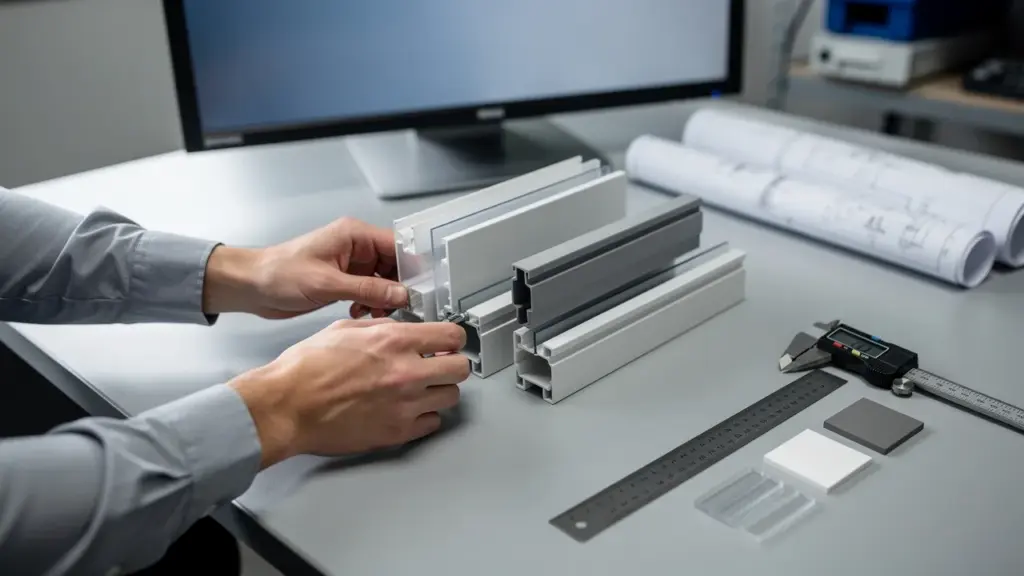
Confirm constant-section fit
Rigid plastic profiles are harder, relatively inflexible shapes that can serve as durable alternatives to metal products in external environments. A rigid profile is a strong extrusion candidate when its cross-section stays constant along its length and its material can meet service and fit requirements. Examples include channels, trim, tubing, lighting lenses, and other custom linear shapes made by forcing molten plastic through an extrusion die.
Extrusion usually fits a component with the same cross-section along its length, such as a rail, channel, wire guard, tube, or edge trim. The die creates a continuous form that can be cut to the required length, while injection molding creates individual parts inside a mold. Start with the cross-section, not the finished part label.
The extrusion process moves plastic through a heated barrel, where a rotating screw advances and melts it. The plastic usually enters a barrel sitting around 200 to 275 ℃, then passes through a die, cooling stage, haul-off, and cutting operation. Choose extrusion when you need a continuous length and the actual production resin rather than a shape-only sample.
Screen the application and service requirements
Screen the application before you refine the profile. Rigid plastics work well when durability and impact resistance matter, while flexible plastics can be engineered to mimic rubber-like physical properties. Your first decision is whether the component needs stiffness or controlled flexibility at the section, edge, or contact area.
Record the service conditions that could affect material review:
- Operating temperature requirements.
- Outdoor or UV exposure.
- Required color or opacity.
- Flame-resistance requirements.
- Contact with chemicals, wiring, or other parts.
- The fit, sealing, insulation, protection, or support function the profile must provide.
Plastic materials can be designed around operating temperature, UV resistance, coloration or opacity, and flame resistance requirements. Keep each requirement tied to the part function. In a high-moisture application, plastic can provide mildew resistance, so record moisture exposure as part of the material review. Plastic may also be a solution when the component requires anti-static properties; state that requirement explicitly instead of leaving it implied by the drawing. Colored polymers can replace painting or powder coating, creating time savings and consistent color throughout the part. Record whether color or opacity applies to the entire profile or to a defined surface, because the supplier needs the appearance requirement alongside the selected material. Use these details to distinguish a material requirement from a cosmetic preference during supplier review. A rigid profile that must resist moisture, control static, and maintain a defined appearance needs each condition stated separately in the RFQ.
A constant cross-section is a strong process fit, but it does not answer every suitability question. Check whether the profile must run continuously, whether its length matters, and whether the section must remain rigid during installation and service. If the part needs changing geometry along its length, record that condition before treating extrusion as the production route.
Channels, rails, wire guards, tubing, trim, and similar parts share the repeatable geometry that extrusion produces. Record whether your profile must support, guide, seal, insulate, or protect another component so the supplier can relate the drawing to its function.

Match the chosen material to the profile need
Rigid PVC, or uPVC, is a thermoplastic used in construction and industrial applications. Its lack of plasticizers makes it more rigid than flexible PVC; rigid PVC has strength, stiffness, and toughness, while flexible PVC contains plasticizers that increase softness and flexibility. Rigid PVC extrusions also have chemical resilience, corrosion resistance, and insulation properties for low-voltage electrical uses.
Keep the chosen resin explicit in your drawing and RFQ. Rigid extrusion materials include ABS, rigid vinyl, high-impact polystyrene, polycarbonate, butyrate, propionate, and PETG. HIPS is a rigid, economical, lightweight plastic used for rigid profile and tubing extrusions. These options are a starting point for supplier review, not a substitute for your service requirements.
Use the material record to connect the resin with the profile function. Rigid PVC is described as tough, economical, inherently flame retardant, resistant to most chemicals, and available in formulations that can be clear, opaque, weather resistant, high tensile strength, or impact resistant. If you need welding, gluing, fusing, machining, or low-voltage insulation, list that operation or requirement separately.
The material handoff should identify the resin you have selected and the reason it fits the service requirements. State whether rigidity, impact resistance, chemical resilience, insulation, color, opacity, UV resistance, or flame resistance drives the choice. Ask the extrusion supplier to review manufacturability against that defined material rather than choosing a resin from the profile shape alone.
Test the cross-section before tooling
Test the geometry before tooling by reviewing the shape, dimensions, wall thickness, and functional surfaces together. Keep wall thickness as even as the function allows because thick and thin sections cool at different speeds and can cause warping or sink marks. Round sharp internal corners where possible; sharp corners create weak points and make the die harder to balance.
Design the section around material behavior after it leaves the die. The profile cools, shrinks, and stabilizes outside the tooling, and die swell means the die opening is not an exact copy of the drawing. Simple cross-sectional dimensions can typically hold tighter tolerances than compound dimensions, which accumulate variation. Mark the dimensions that control assembly, sealing, sliding, or retention.
One cited extrusion provider lists a profile envelope up to 39.4 × 39.4 in (1,000 × 1,000 mm), including open, closed, solid, hollow, and multi-wall sections. That figure describes the cited provider’s listed range, so use your own drawing review to establish whether the proposed section is workable. Include the complete cross-section and units in the RFQ.
The geometry review should separate the features created by the die from features added afterward. Show wall transitions, internal corners, cavities, and functional surfaces in the cross-section, then mark holes, slots, notches, or machining as secondary features. This separation gives the supplier a clear basis for reviewing material flow, tooling, tolerances, and post-extrusion work.
Set tolerances around fit and function
Set tolerances from function outward. Identify mounting faces, sealing lips, slide channels, retention features, and other dimensions that control fit or operation. Give less restrictive treatment to surfaces that are cosmetic or nonfunctional. Overly stringent tolerances can increase tooling costs, setup times, and scrap rates, so do not apply a tight band to every dimension.
Rigid plastics can hold closer tolerances than flexible materials, but thermal expansion and contraction still require allowance. Design the tolerance around the material, profile shape, measurement condition, and expected use. A simple dimension may be easier to control than a compound dimension, even when both appear similar on the drawing.
Cut length belongs in its own requirement rather than being implied by the cross-section. A typical extrusion length tolerance is ±1/16 inch, and the tolerance may increase proportionally for longer lengths; the actual value varies with material properties, profile design, and cutting method. Put the required length, allowable variation, and measurement method in the RFQ.
The tolerance record should identify datums and distinguish critical dimensions from general dimensions. A mounting face, sealing edge, or slide channel may need tighter control than a broad decorative surface. Tie each tight tolerance to the function it protects, then state how that feature will be inspected.
Add color, volume, and secondary features to the RFQ
Build the RFQ around a drawing, clear CAD file, physical sample, or specified dimensions. A clear CAD file helps a supplier evaluate geometry, material flow, tooling, tolerances, and secondary operations. Include the chosen material, color, surface finish, annual volume, order quantity, required lengths, packaging format, and the application conditions that affect acceptance.
Use this drawing and RFQ checklist:
- Complete cross-section with units and datum references.
- Critical dimensions and their functional tolerances.
- Cut length and length tolerance.
- Straightness and twist limits.
- Surface texture, gloss, color, opacity, and cosmetic zones.
- Holes, slots, notches, machining, punching, or other secondary features.
- Inspection points and acceptance criteria.
This record gives the supplier a defined part to review rather than a general shape description.
Plan post-extrusion work before the die is designed. Drilling and CNC routing can add features that extrusion alone cannot achieve, and treating those operations as an afterthought can create problems later. If the section needs two materials, a flexible lip, a flexible flap, or a flexible hinge, co-extrusion can combine rigid and flexible materials in one profile. Two-color co-extrusion can create two colors or a dominant color with a contrasting stripe.
The volume record should separate annual demand, typical order quantity, cut length, and packaging requirements. State whether drilling, routing, punching, or cutting applies to every part or only to a defined production format. Early definition of these details lets the supplier review the continuous extrusion route and secondary work as one project.
Plan tooling, first article, and production timing
Plan the project as a sequence: profile review, die development, sampling, production, and final inspection. Profile complexity is a major factor in custom extrusion lead times. Simple shapes with standard dimensions generally require less preparation than intricate profiles with tight tolerances or specialized performance requirements.
Die design and fabrication commonly take several weeks, depending on profile complexity and shop backlog. First-article sampling and dimensional approval follow die work before full production. Simple profiles may move from sample review to first-article production in a matter of weeks, while complex projects may take longer. Request a timeline estimate after the supplier reviews your drawing or sample and assesses the work involved.
Treat first-article approval as a formal production gate. Check samples against the drawing and tolerances, allow for one or two tuning cycles, and approve production in writing only after the required dimensions, resin, and any co-extruded materials have been verified. Keep the acceptance record with the released drawing.
A cited supplier reports critical profile tolerances of ±0.010 in (±0.254 mm) or better and recommends placing critical dimensions and inspection datums on the drawing. Treat that number as the cited provider’s reported capability, not as a universal tolerance for every rigid profile. Your drawing must still identify which dimensions control the part.
The timing record should keep die work, first-article review, approval, and production as separate milestones. Do not combine a tooling estimate with a production estimate. Give the supplier the complete drawing, tolerance requirements, material, and expected volume before requesting a schedule so the estimate reflects the actual project scope.

Screen rigid behavior, material, and fit
Close these open items before releasing the drawing:
- Which dimensions control assembly or function?
- How will straightness, twist, length, and surface requirements be inspected?
- Are holes, slots, notches, drilling, routing, or punching part of the finished requirement?
- Does the color or finish requirement apply to the full section or a defined surface?
- Does the annual volume support the proposed tooling and production route?
Route unresolved technical questions to qualified engineering or extrusion-supplier review.
Keep the drawing revision and acceptance criteria together in the project record. This record distinguishes an open design question from a released production requirement.
Qualified technical review becomes necessary before tooling when service conditions are undefined, fit-critical dimensions lack tolerances, or the section includes secondary work that is not shown on the drawing. Seek the same review when a flexible zone, rigid zone, hinge, lip, flap, or color arrangement depends on co-extrusion. Resolve those conditions before production approval. If you are unsure whether the profile, material, tolerances, or service requirements are suitable, contact a qualified engineer or extrusion supplier promptly before tooling or production approval.
Send the fit decision with the drawing
Use the record to state the result of the suitability screen: whether the constant cross-section fits the application and which dimensions control fit. Attach the drawing or CAD file, then add the chosen material, annual volume, and timing for supplier review. A qualified engineer or extrusion supplier should make the final suitability decision for your application before production release.
We invite OEMs to discuss their custom profile needs. Prepare the drawing or sample, chosen material, annual volume, color, secondary-operation details, and timeline expectations before sending the project record.
Questions to resolve before requesting a rigid profile quote
What annual volume is typically appropriate for rigid plastic profiles?
Lincoln Plastics typically works with buyers running about 10,000 feet or more per year. Include annual demand, typical order quantity, and cut length in the RFQ so the production route can be reviewed against the actual requirement.
Who owns the extrusion tooling after it is made?
The customer owns the tooling, and tooling is paid separately from production. Record the tooling charge and ownership terms as separate commercial items when reviewing the project scope.