

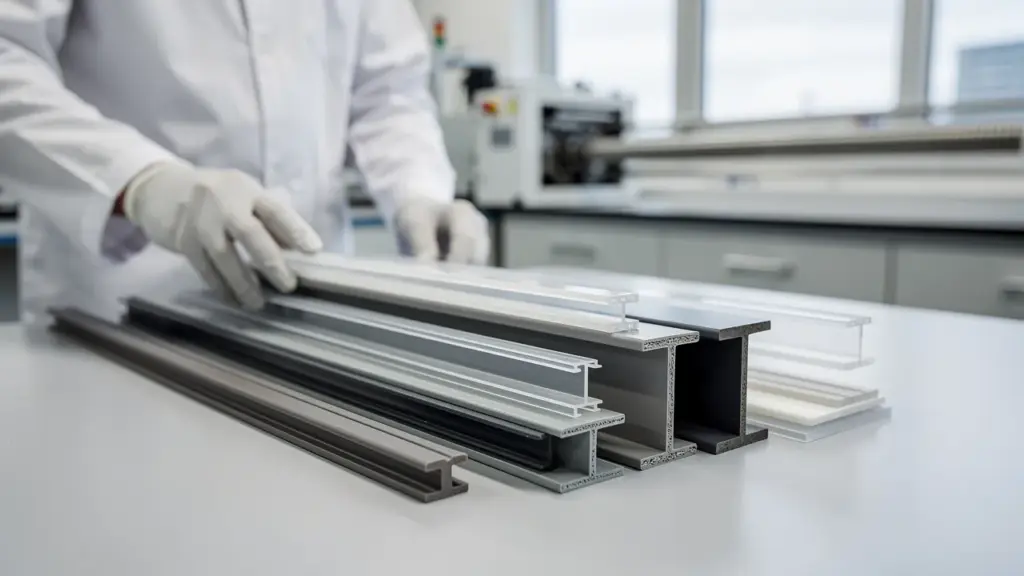
Define the cap-stock construction
Capstock is a co-extruded outer protective layer applied over a plastic substrate. The construction places a surface material over a core so the finished profile combines two defined material zones.
Co-extrusion can produce the core material and cap layer simultaneously in a single manufacturing pass, bonding them while both materials remain molten. The process forms the layer arrangement as the materials move through the die.
The co-extrusion process uses two separate extruders feeding into one die head. Channels in the die position the cap layer around the outside of the core stream, so your drawing must identify which material belongs in each zone.
The cross-section should show a core, an outer layer, and a defined interface between them. The core is the underlying plastic substrate, while the cap forms the exposed surface; both materials become one co-extruded part during the same manufacturing pass. Describe that arrangement before discussing color, finish, or surface requirements.
Match the cap to the required surface function
The required surface function should determine whether an outer layer belongs in your design. Capstock layers can help protect the underlying material from UV exposure, weathering, and surface wear while maintaining color, gloss, and surface quality.
Use cap stock when the exposed surface has a requirement that the core alone does not address and the design can assign that requirement to a defined layer. The drawing should identify the exposed faces, because a cap requirement for one face does not establish cap coverage for every face. The RFQ should connect each exposed face to its required finish, color stability, wear resistance, or weatherability.
Your application record should identify the exposure that creates the surface requirement. Separate outdoor exposure, color retention, scratch contact, stain contact, and appearance requirements rather than describing the need as general durability.
An application record should separate the exposure condition from the acceptance result. Outdoor exposure is the condition, while color stability or weatherability is the result the cap must support. Scratch contact is the condition, while scratch resistance is the result to inspect. Separating exposure conditions from acceptance results gives the extruder a performance target instead of a broad durability label.
Capstock thickness can be controlled based on requirements such as UV resistance, color retention, scratch resistance, and weatherability. State the required thickness or the performance requirement that determines it, then have the extrusion review connect that requirement to the layer arrangement.
Surface review should answer five questions:
- What UV and color-stability requirement applies?
- What scratch and stain resistance does the application require?
- What surface finish and gloss are acceptable?
- What cap thickness or coverage supports that function?
- What service exposure makes each requirement necessary?
This checklist gives the drawing and RFQ a defined surface task instead of a broad request for protection.

Screen compatibility before specifying materials
Capstock compounds are typically formulated from PVC, polyolefin-based polymers, or acrylic materials. The material family is only the starting point; the selected cap and core grades still need to work together in the proposed construction.
The capstock material must be chemically and mechanically compatible with the underlying substrate to achieve proper adhesion. PVC capstocks are typically paired with PVC substrates, while polyolefin capstocks are used over compatible polyolefin-based profiles or composites.
The capstock material must flow consistently and form a smooth, uniform surface with the desired gloss and appearance. Your material review should therefore cover both adhesion to the core and the way the cap material flows through the die.
Flow review should cover the full exposed geometry, not only a flat reference surface. The drawing should identify corners, transitions, and other exposed features where cap coverage or appearance matters. The extrusion review can then relate the cap material’s flow behavior and layer control to the specified cross-section.
Differences in melt behavior, thermal expansion, or surface energy can affect adhesion and appearance during co-extrusion and bonding. Material compatibility, melt temperature, viscosity, moisture, layer thickness, interface pressure, and die design can also determine whether finished layers maintain interlayer adhesion or begin to peel and delaminate.
Compatibility screening should address the following points before you release the material arrangement:
- Compatibility of the proposed cap and core grades.
- Melt temperatures and viscosity balance.
- Moisture or volatile contamination controls.
- Interface temperature and pressure.
- Layer thickness and die geometry.
- The inspection or test used to assess adhesion and appearance.
Layer separation may be caused by poor polymer compatibility, and weak peel strength may be associated with interface temperature or pressure that is too low. Record the answer for each point in the RFQ.
Name the construction accurately
A standard capstock arrangement uses two materials: a core and an outer cap.
Tri-extrusion uses three or more streams. A construction may include a rigid substrate, a tie layer, and a weatherable cap, so an RFQ that requires an intermediate bonding layer should name tri-extrusion rather than simply requesting a two-material arrangement.
A tie layer is a separate material zone between a core and a cap, not merely a thicker cap. If the proposed construction depends on an intermediate zone, the cross-section should identify that zone and assign its material and coverage separately. If the design uses rigid and flexible grades of the same chemistry, the drawing should identify the hardness boundary instead of calling the entire part cap stock.
Dual durometer generally describes a co-extrusion in which the same base chemistry appears in both a rigid and a flexible grade. Rigid and flexible PVC provide the classic example; this construction describes different hardness zones, not automatically an outer protective cap.
Lamination uses pre-existing layers. Use the manufacturing method and layer count in your description so the quote addresses the intended architecture.
Construction language should identify four items: the core material, the cap material, any tie layer, and the joining method. Some polymers lack adhesion and are not suited to direct co-extrusion; a conductive intermediate layer can often resolve this problem where that layer fits the design.

Convert the design into drawing and RFQ requirements
The drawing or RFQ should make the material arrangement measurable. Mark the core, cap coverage, layer boundaries, target cap thickness, overall dimensions, and the dimensions that control fit or function.
Your project record should include these construction details:
- Core material and cap material, including the proposed grades when known.
- Areas that receive the cap and areas that remain core material.
- Target cap thickness, overall dimensions, and critical cross-section dimensions.
- Surface finish, gloss, color, and additive requirements.
- UV, color-stability, scratch, stain, weatherability, or other application requirements.
- Annual volume, expected order pattern, and cut or packaging requirements.
A marked cross-section gives the extruder a defined layer arrangement to review.
Performance requirements should sit beside the dimension or surface they affect. Certifications or performance benchmarks may be needed to support product warranties or market requirements, so identify any required certification, accelerated-weathering result, application-specific test, or customer acceptance criterion in the RFQ.
Acceptance criteria should distinguish visual review from measured results. State whether approval depends on appearance, cap thickness, dimensions, adhesion, accelerated-weathering results, or another application-specific test. Each criterion should identify the record or result required for approval, so the supplier can discuss inspection expectations with the quote.
Color and additive requirements belong in the material section rather than in a general appearance note. Our colorant partners can match any color with your additive package and source colors to Pantone specifications; provide the target color, additive package, and approved color reference.
Quality expectations should state how you will judge the finished layer. Define the required surface appearance, cap coverage, critical dimensions, adhesion expectation, and applicable test or certification records so the quote discussion addresses acceptance requirements rather than material names alone. Lincoln Plastics is ISO 9001:2015 certified and uses documented quality procedures, dedicated quality books, and in-process checks for production. A project quality plan should identify the required cap coverage, dimensions, appearance, and adhesion checks. Application-specific tests or certification records should be identified separately from routine production checks. The RFQ should state the records required for acceptance so the supplier can distinguish construction requirements from broader application requirements. This separation gives procurement and engineering a shared basis for reviewing the proposed cap-stock construction.
Resolve the process basis before requesting a quote
The process basis should account for the temperature and flow relationship between the cap and core. Ask the extruder to review the proposed material arrangement, interface conditions, layer control, and die approach before treating the construction as ready for quotation.
The process review should identify which downstream step affects cap coverage, surface appearance, dimensional results, or cut-length acceptance. The RFQ should state the required cut length and packaging requirements when those details affect the delivered part.
When different plastics have a significant processing-temperature difference of 20 degrees or more, multi-manifold extrusion dies are recommended rather than a feed block. Give the proposed materials and processing temperatures to the extrusion engineer so the die approach can be evaluated against this condition.
Tooling is paid separately and owned by the customer. Profile tooling costs $15,000-$60,000, pipe tooling costs about $5,000, tooling lead time is 8-16 weeks, and first article approval is required. The RFQ should separate tooling cost, ownership, lead time, and first article approval from the recurring part requirements.
The quote review should identify the proposed feed arrangement, die type, layer-control basis, and material interface conditions. The response should connect the selected process to the specified layer coverage, cap thickness, surface requirement, and adhesion requirement.
A part quote takes 2-3 days, while a reply to an inquiry comes within one business day. Repeat-order lead time is 2-10 days. State whether the request concerns new tooling or repeat production so the timing discussion addresses the correct project stage.

Escalate unresolved technical requirements
Unresolved material compatibility should be handled before the design moves into production planning. Ask a qualified extrusion supplier to evaluate the cap and core chemistry, expected adhesion, layer thickness, melt conditions, and surface requirement together.
Technical review should close three decision gates:
- Compatibility: the proposed materials can form the required interface.
- Process: melt behavior, temperature, viscosity, moisture, pressure, and die design support the layer arrangement.
- Acceptance: the drawing identifies the surface, dimensional, adhesion, and testing requirements.
Keep each unresolved item visible in the RFQ until the responsible technical contact has supplied a construction-specific answer.
Layer separation may be caused by poor polymer compatibility, while weak peel strength may be associated with interface temperature or pressure that is too low. Keep the proposed corrective path tied to the actual failure mode rather than adding a tie layer or changing the material without technical review.
Application-specific testing or performance benchmarks may be needed where a warranty or market requirement depends on surface performance. Put that requirement in the RFQ and identify the result needed for approval before the construction is released. Evaluate the proposed interface after extrusion and under the application’s service conditions. Separate initial appearance from the required service result and identify the check or test for each.
Send the project record for a construction-specific quote discussion
We offer custom profile extrusion solutions tailored to the needs of OEMs across various industries. Send a construction record that identifies the core, cap, layer coverage, dimensions, surface requirements, annual volume, and quality expectations.
We provide pipe, tube, and profiles for irrigation, industrial, electrical, marine, trucking, and construction industries. We work closely with OEMs to meet quality requirements, including special checks for fit and function, and we produce a large variety of custom-diameter pipe with various thicknesses and colors.
Send Lincoln Plastics the drawing, chosen core and cap materials, application, dimensions, annual volume, color or additive requirements, and quality criteria. A qualified extrusion supplier should make the final suitability decision for the proposed construction, including its material compatibility, layer arrangement, and acceptance requirements.