

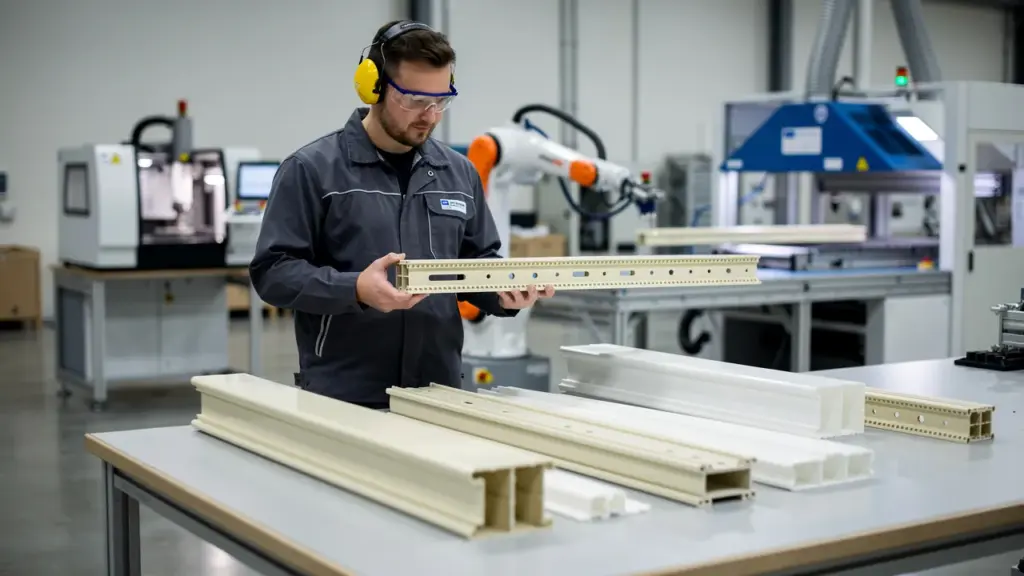
What Makes an Operation Secondary in Plastic Extrusion
Secondary operations are fabrication or finishing work performed after an extruded part leaves the extrusion line. These steps transform continuous output into a finished or semi-finished profile, pipe, tube, or other part ready for assembly, packaging, or direct use. Treat each required feature as part of the production plan, not as an isolated finishing request.
The primary process establishes the basic part form, while secondary operations complete requirements the first stage does not provide. Those requirements may include tighter feature dimensions, surface treatment, changed material properties, or assembly features. Mark every feature that must appear along the length, at an end, on a surface, or at a joining point before selecting the production route.
Extrusion applies heat and pressure to force material through a die opening with the desired cross-sectional profile. Downstream equipment may then calibrate, cool, haul off, cut, package, or wind the extrudate, depending on the end product. Separate the cross-section created by the die from every feature added afterward.
Start with a feature map. For each requirement, record whether the die creates it or whether a later operation creates it. This simple division gives you a usable basis for discussing sequence, equipment, inspection, and the information needed in an RFQ.
Decide When the Operation Belongs in the Production Sequence
Downstream extrusion equipment may calibrate, cool, package, haul off, cut, or wind the extrudate, depending on the end product. Identify the point where your required feature must be created, then ask whether the line sequence can accommodate it.
In-line operations are performed during standard manufacturing procedures, while post-extrusion finishing and decorating are performed once parts are extruded. Secondary operations may also occur between major production stages rather than only at the end. Record the proposed point in the route because timing changes the handling, inspection, and sequence questions that belong in the RFQ.
In-line and offline systems provide two production-route options. Choose between them using the part geometry, material, volume, timeline, and tolerance requirements.
| Route | When the work occurs | Planning association |
|---|---|---|
| In-line | During standard manufacturing procedures | Associated with the lowest piece price and high consistency |
| Offline | After extrusion or between production stages | Associated with fast development and extremely tight tolerances |
Use these associations to frame a manufacturer discussion. Do not select a route from the feature name alone.
Build the sequence in order before requesting a route recommendation:
- Define the continuous cross-section and finished length.
- Mark each feature added during or after extrusion.
- Place cutting, forming, joining, marking, or surface work at the required stage.
- Assign an inspection point after each feature that affects assembly or function.
Give the manufacturer this sequence with the drawing so the proposed equipment arrangement can be reviewed against the end product.

Match Profile Features to Secondary Operations
Drilling or CNC routing can be used when punching is not practical, when geometry requires it, or when tolerances demand more control. Locate each hole, slot, cut, or machined area on the drawing and state whether its position is measured from an end, a feature, or a continuous reference.
Thermal bending can create curved or angled sections within extruded profiles. Joining options include mechanical fastening, bonding, snap-fit joints, welding, and assembly, with the joining method dependent on required strength and whether disassembly is needed. Ultrasonic welding can join sections of extruded profiles, including plastic to plastic, plastic to vinyl, and plastic to metal.
Lamination applies a protective or decorative layer to an extruded profile. The layer can enhance appearance, provide additional protection, and allow easier cleaning. Other plastic secondary operations can include painting, coating, plating, and machining. Put the surface requirement beside the drawing feature that needs it, including the covered area and the assembly function affected by the finish.
Laser marking technology can produce high-contrast markings on plastic and metal surfaces at line speeds while tracking product speed and adjusting marking parameters. Laser cutting is another option for selected features: a CO2 laser is typically used for thin plastic tubing and sheets, while ultraviolet and green lasers can produce cleaner cuts and smaller spot sizes for micro holes and cuts. State whether the marking or cut is functional, identification-related, or cosmetic.
Match the operation to the feature rather than choosing a process by habit:
- Use cutting or punching for defined openings or lengths.
- Consider drilling or routing when geometry or control makes punching unsuitable.
- Consider thermal bending for curved or angled profile sections.
- Define joining by strength and disassembly requirements.
- Define marking, lamination, coating, or other surface work by the area and function involved.
Carry the selected operation into the drawing and RFQ instead of leaving it as a general finishing note.

Choose the Process Route from Part Requirements
Part geometry, material, volume, timeline, tolerances, surface requirements, and assembly function should drive the operation and its sequence. The appropriate sequence depends on how those requirements interact. Build a short requirement record before asking a manufacturer to select in-line or offline work.
Plastic extrusion tolerances are naturally wider than machined metal tolerances because of thermal expansion and contraction. Polymers are also sensitive to environmental conditions such as temperature and moisture absorption. Mark functional dimensions separately from reference dimensions, and identify the temperature, moisture, mating, or assembly condition that affects each critical feature.
A process-route review should answer four questions before approval:
- Does the operation fit the profile, pipe, or tube geometry?
- Does the material support the proposed forming, cutting, marking, joining, or surface work?
- Does the selected route fit the production volume and timeline?
- Do the operation and sequence support the stated tolerances, surface requirements, and assembly function?
Give the manufacturer the complete set rather than asking for a route from a feature name alone.
For every feature that affects fit or function, record the measurement condition with the dimension. Include the reference surface, allowable variation, environmental condition, mating part, and inspection method. This information helps separate a requirement caused by the part from a requirement caused by the assembly.
Secondary operations can enhance final-product quality and reduce the likelihood of rework or rejection during quality control. Define the inspection point for each critical feature so the production route and the quality check address the same requirement. Keep the inspection method next to the feature in the RFQ.
Account for Setup, Timing, and Cost Drivers
Each secondary operation requires setup, processing, and inspection time. The added work therefore creates more steps in the production cycle. List every operation separately in the RFQ, including its setup or tooling requirement, processing point, inspection point, and handling between stages.
Process optimization can reduce the effect of added operations on production cycle time by identifying time savings, using more efficient tooling, or reducing equipment setup time. Ask the manufacturer to explain the proposed sequence and where setup occurs. A clear sequence gives both sides a defined basis for discussing timing.
Secondary-operation time and money depend on the device itself. Welding and soldering can be labor intensive, which can increase piece costs and production times, while ultrasonic welding and pad printing require additional capital and equipment that can increase up-front costs. Treat labor, equipment, setup, inspection, and handling as separate quote questions.
If a required operation is introduced late, manufacturing costs and production time may increase. Equipment, paperwork, change requests, and operator retraining may then be added to the route. Record secondary work before design release so a later process change does not become the first time the operation appears in the production plan.
Ask these timing and cost questions for each added operation:
- What setup is required before production begins?
- Where does the operation occur in the sequence?
- What inspection follows it?
- What handling or packaging occurs afterward?
- Which labor, equipment, or paperwork assumptions belong in the quote?
Use the answers to compare complete production routes rather than comparing an extrusion price against a route that omits secondary work.
Record the Operation Clearly in an RFQ
An RFQ record should connect each secondary feature to the drawing and production route. State the feature, its location, the chosen material, the required volume, the applicable tolerance, the inspection method, and the proposed sequence. The exact selection and arrangement of extrusion-system components depends on the end product, so provide enough part context for a route discussion.
A secondary-operation checklist should contain the following items:
- Feature type, such as cutting, punching, drilling, routing, bending, marking, joining, or lamination.
- Feature location and orientation on the profile, pipe, or tube.
- Drawing dimension, tolerance, surface requirement, and inspection method.
- Material, cross-section, finished length, production volume, and required sequence.
- Packaging or handling requirements after the operation.
- Whether the proposed work is in-line, offline, or performed on-site.
Ask which operations the manufacturer performs on-site and what equipment it uses.
Secondary-operation methods influence accuracy, cost, and consistency. Record the reason for the proposed method instead of listing only the operation name. For example, identify whether drilling replaces punching because of geometry, because punching is impractical, or because the feature requires more control.
Secondary operations can be engineered into the extrusion process from the beginning of a project. Add them before the drawing and RFQ are released, then ask how the selected in-line or offline route affects the feature record. Early documentation gives the manufacturer a defined basis for discussing the operation, inspection, and production sequence.
Send the information in an order that follows the part:
- Drawing and cross-section.
- Chosen material and service conditions.
- Feature locations and required dimensions.
- Operation and sequence for each feature.
- Volume, timeline, inspection, and packaging requirements.
- Questions about in-line, offline, or on-site processing.
This order connects the feature to its manufacturing condition instead of presenting a disconnected list of services.
Get Qualified Review Before Approving an Unresolved Process
Escalate to qualified engineering or manufacturing review before approval when geometry, material behavior, environmental conditions, tolerances, surface requirements, or assembly sequence remain undefined. Consider secondary operations during extrusion design rather than treating them as an afterthought, because unplanned fabrication requirements often create problems that are expensive to fix later. Bring the drawing and the unresolved requirement to the review.
A feature review should test whether the proposed operation matches the part rather than relying on a familiar process name. Drilling or CNC routing may fit a geometry that makes punching impractical, while temperature and moisture sensitivity may affect how an extrusion is measured or assembled. Ask for the operation, sequence, tolerance basis, and inspection method as one connected decision.
Request review immediately when any of these conditions apply:
- A feature location or datum is still open.
- The material or environmental condition may change measurement or assembly.
- The proposed operation could alter a surface needed for joining or inspection.
- The tolerance is tighter than the surrounding extrusion requirement.
- The sequence could affect the part’s assembly function.
Keep the unresolved item visible in the RFQ until the manufacturer addresses its process and inspection implications.
Close the review with a written process record. It should name the operation, the stage where it occurs, the relevant material and tolerance conditions, the inspection method, and any remaining question. This record gives you a clear release point and prevents a secondary feature from appearing later as an unplanned production change.
Send the Part Record for a Quote Discussion
Prepare one part record with the drawing, chosen material, annual volume, required secondary features, critical dimensions, inspection requirements, sequence questions, and timeline expectations. State which features are created by extrusion and which are added through cutting, forming, joining, marking, finishing, or assembly. A qualified engineer or manufacturer should decide whether the proposed route suits your specific part.
Secondary operations belong in the extrusion decision from the first design review through production release. Submit the complete record when the feature, material, volume, tolerance, inspection method, and unresolved questions are ready for discussion.
What Should You Confirm Before Requesting a Secondary-Operations Quote?
What is the difference between primary and secondary operations in manufacturing?
A primary process establishes the basic part form. A secondary operation adds fabrication, finishing, marking, joining, assembly, or another feature that the first process does not provide. For plastic extrusion, the die creates the continuous cross-section; later work creates features such as holes, bends, markings, or assembled ends.
Are secondary operations performed inline or after extrusion?
They may be performed inline during continuous production, offline after extrusion, or between major production stages. Choose the route according to the part geometry, material, production volume, timeline, tolerances, surface requirements, and assembly function. Record the proposed stage in the RFQ because it affects handling and inspection.
How do secondary operations affect manufacturing cost and lead time?
Each added operation can require setup, processing, inspection, handling, labor, equipment, or additional paperwork. The effect depends on the part and the proposed route, so request separate assumptions for each operation rather than comparing extrusion alone with a complete production route. Define the work early because late additions may increase production time and cost.
What should an RFQ include for secondary operations in manufacturing?
Include the drawing and cross-section, chosen material, finished length, production volume, feature locations, dimensions, tolerances, surface requirements, inspection method, operation sequence, packaging needs, and timeline expectations. Identify which features come from extrusion and which require cutting, forming, joining, marking, finishing, or assembly. Ask whether each operation is performed inline, offline, or on-site and what equipment is used.