

What “co-extruded” means in plastic profile extrusion
Co-extrusion is a plastic profile process that combines two or more thermoplastic materials through one die to create a unified profile. Unlike a single-material extrusion, the process uses a main extruder together with one or more co-extruders. The separate extrusion streams meet at the die and leave it as one continuous profile rather than as separate pieces.
A co-extruded profile can integrate different materials, colors, or finishes in one profile. The point is not simply to add a second material; the point is to place distinct characteristics where the design needs them. One portion may provide a different visual finish, while another portion contributes a different material property. The actual combination depends on the materials, geometry, interface, and production requirements defined for the part.
For an OEM purchasing manager, the term describes a manufacturing approach, not a complete specification. It does not by itself identify the resin, color, tolerance, interface behavior, production quantity, or application suitability. Treat it as a prompt for a more precise sourcing discussion.
The first question is therefore simple: does your profile need distinct characteristics integrated into one continuous shape? If the answer is yes, co-extrusion may belong in the design conversation. If a single material already meets the required function, a simpler profile may address the requirement with fewer process variables.
Single-material and co-extruded profiles solve different design problems
Single-material extrusion and co-extrusion solve different design problems because they create different relationships between the process and the finished profile. A single-material profile derives its properties from one material. Co-extrusion can combine multiple properties within one profile, but it also introduces a more complex process and an interface between components.
| Sourcing criterion | Single-material profile | Co-extruded profile |
|---|---|---|
| Extrusion arrangement | One extruder and one material stream | A main extruder with one or more co-extruders |
| Property strategy | Properties linked to one material | Multiple characteristics integrated within one profile |
| Visual treatment | One primary material, color, or finish | Different materials, colors, or finishes can be combined |
| Functional role | Suitable where one material addresses the requirement | Relevant where distinct functions such as sealing, insulation, or multi-material performance need to coexist |
| Process consideration | Simpler process description | More complex process with added interface and coordination questions |
| Cost consideration | The simpler process may carry lower production cost | Added complexity can increase cost, so functional value must justify the approach |
The table is a screening tool, not a final selection rule. A single-material profile is not automatically inadequate, and a combined profile is not automatically an improvement. The appropriate choice depends on what your part must do, where each characteristic must appear, and what production constraints apply.
Use the distinction to avoid a common purchasing mistake: asking for the more elaborate process before defining the problem. Start with the required functions. Then ask whether one material can supply them in the needed geometry. Explore co-extrusion when two or more distinct characteristics must be integrated rather than added as separate downstream components.
How multiple extrusion streams become one profile
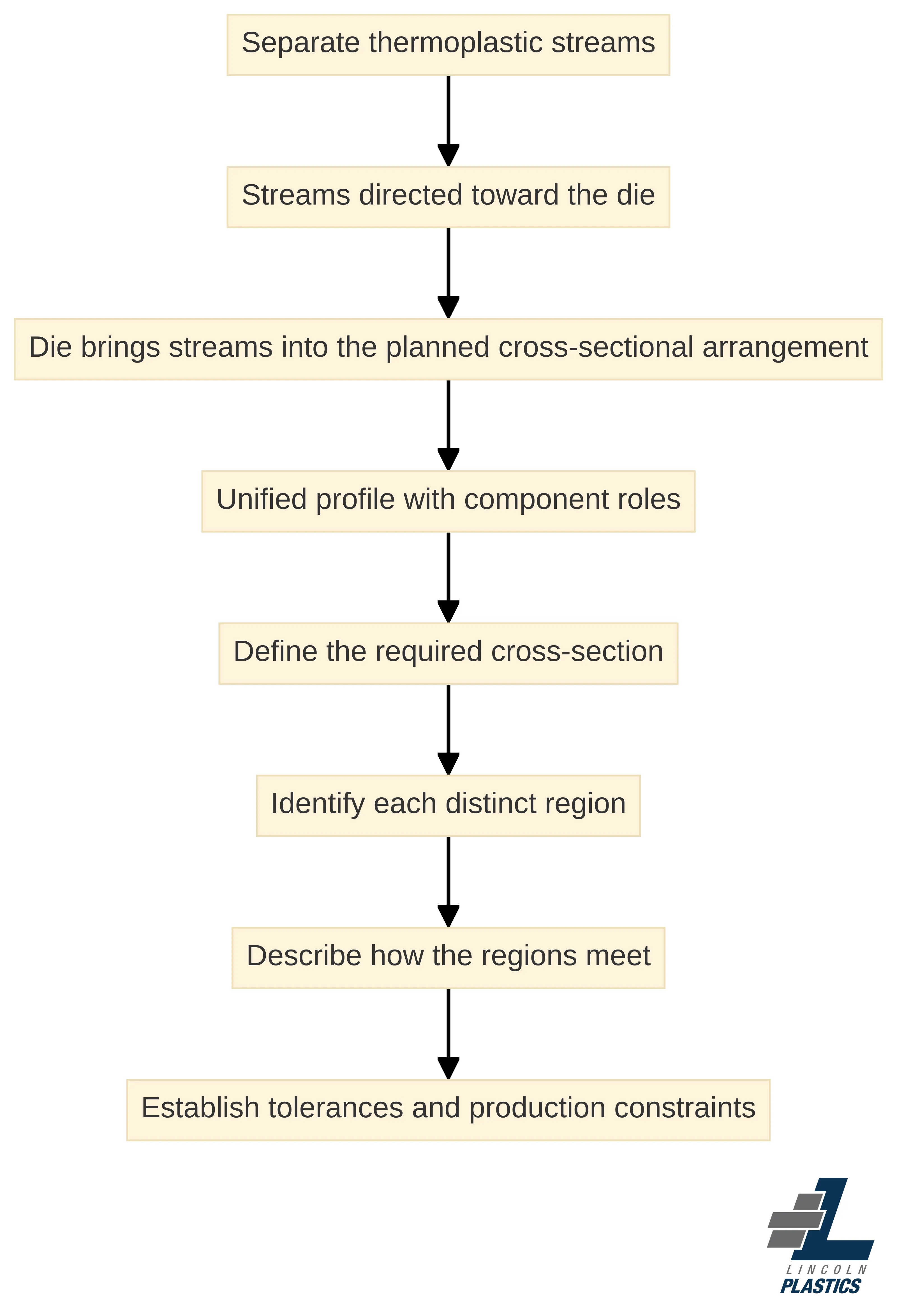
The co-extrusion process begins with separate thermoplastic streams that are directed toward a die designed for the intended profile. A main extruder supplies one stream, while one or more co-extruders supply additional streams. The die has multiple openings or flow paths that bring those streams into the planned cross-sectional arrangement.
That location matters because a material placed along an edge, in a sealing region, or on a visible surface serves a different design purpose from a material placed in the interior. A color or finish may occupy a defined visual region. A second material may occupy a region intended to contribute a different characteristic. The process therefore connects material placement to profile geometry rather than treating the materials as interchangeable throughout the part.
The resulting shape is unified, but unified does not mean that every region has identical behavior. Each component retains a role within the cross-section. The interface between those regions becomes part of the finished profile and must be considered alongside the external dimensions.
A useful sourcing conversation follows the physical sequence:
- Define the required cross-section and identify each region that needs a distinct characteristic.
- Identify the material, color, or finish proposed for each region without assuming that the labels alone establish compatibility.
- Describe how the regions meet and what the interface must withstand in the intended application.
- Establish the tolerances and production constraints that apply to the complete profile.
This sequence keeps the discussion tied to the part you need rather than to the process name alone.
When integrated characteristics may justify co-extrusion
Integrated characteristics may justify co-extrusion when your profile needs more than one distinct function in a single continuous shape. A source comparison identifies sealing, insulation, and multi-material performance as examples of technical requirements that can make the approach relevant. Another description says that different plastics may combine characteristics such as stability, flexibility, or protection from heat or chemicals, depending on the plastics selected.
The practical question is not whether a second material sounds useful. The practical question is whether the second material has a defined job that cannot be addressed as clearly by a single-material profile or by a separate component. You might explore the process when the design needs a contrasting visual region, a distinct sealing area, or two material characteristics within one profile. Those are design reasons to investigate, not conclusions about suitability.
Use these prompts to test whether the added process has a clear purpose:
- Does one continuous profile need two visibly different colors or finishes?
- Does one region need a different characteristic from another region?
- Does the design call for an integrated sealing or insulation function?
- Would separate parts create an assembly issue that the profile is intended to address?
- Can you describe the role of each material or color in the cross-section?
If you cannot identify the role of the additional stream, pause before specifying co-extrusion. A process with more components creates more questions. The added complexity should connect to a defined profile requirement, not serve as a substitute for one.
Applications that make co-extruded profiles easier to recognize
Application examples make the concept easier to recognize because they show where more than one characteristic may be useful in a continuous profile. Reported application areas include cable and wire protection, refrigeration seals and profiles, safety products, and commercial construction components. These examples describe categories of use; they do not establish that every design in a category requires co-extrusion.
Cable and wire protection can involve a profile whose geometry, visual treatment, or material regions serve different purposes within the same product. Refrigeration seals and profiles illustrate why a design may need a defined sealing region or a profile associated with insulation-related functions. For an OEM purchasing manager, translate an application label into a part description before contacting a supplier. Ask what the profile must do in the equipment, where it is installed, what surfaces it contacts, and which regions need different characteristics. A category name is too broad to establish a process or material direction.
A compact application screen can help:
- Cable or wire protection: identify the cable path, contact surfaces, bend requirements, and any distinct regions in the profile.
- Refrigeration-related profile: identify the sealing or insulation function, placement, and dimensional requirements.
- Safety product: identify the visible regions, color or finish needs, and the physical role of each component.
- Construction component: identify the profile geometry, exposed surfaces, interface conditions, and required tolerances.
The same discipline applies to industrial equipment. Describe the component’s job and cross-section first; then ask whether integrating characteristics in one profile offers a meaningful design path.
Why the component interface belongs in the sourcing discussion
The component interface belongs in the sourcing discussion because two materials must remain connected in the intended profile arrangement. Material compatibility and interface adhesion require evaluation rather than assumption. Relevant factors can include wettability, diffusion, chemical bonding, impurities, and differences in thermal expansion.
The word “compatible” can hide several separate questions. You need to distinguish whether the materials can be processed together, whether they can form the required interface, whether that interface remains suitable under the intended conditions, and whether the finished geometry stays within tolerance. A material pairing that appears plausible by name alone does not answer those questions.
Interface planning also changes how you prepare an RFQ. Do not list only the two material names. Add the location and width of the interface, the shape of the adjoining regions, the intended application, and the conditions the profile will encounter. If the design includes a visible boundary, a sealing boundary, or a load-bearing transition, identify that role explicitly.
Ask the supplier to address the interface as part of the profile rather than as a footnote:
- Which regions meet at the interface?
- What function must the interface support?
- Which material or grade is proposed for each region?
- What processing or design conditions affect the connection?
- How will the interface be examined or represented in the quality record?
These questions do not select materials for you. They make the material and manufacturing discussion precise enough for technical review.
What interface behavior can affect in the finished profile
Interface behavior can affect dimensional accuracy, residual stress, interface strength, and deformation in the finished part. Differences in thermal expansion are one factor identified in the technical literature, and those differences can influence how the combined profile behaves as it is processed or changes temperature.
Dimensional accuracy matters because an interface can occupy a location that controls fit, sealing, alignment, or appearance. Residual stress matters because the profile may not respond uniformly when adjoining regions have different thermal behavior. Interface strength matters because the combined regions must remain connected for the function assigned to them. Deformation matters because a profile that leaves the die with the intended cross-section still needs to retain that shape.
You do not need to turn an initial purchasing discussion into a complete engineering analysis. You do need to make the relevant behavior visible. Describe the dimensions that control fit, the interface location, the expected application conditions, and the tolerance that matters to the part. Then ask how those requirements will be considered in the proposed process.
Keep these distinctions separate:
- Geometry: what the cross-section must look like and where each region belongs.
- Interface: how the regions meet and what the boundary must do.
- Thermal behavior: how differences between the regions may affect shape or stress.
- Acceptance: which dimensions or interface characteristics must be checked.
A supplier discussion that addresses only the external outline leaves the internal transition undefined. Include both.
Questions to clarify about profile design and component placement
Profile design questions should identify the required cross-section before you discuss process details. Co-extrusion places multiple streams into one unified profile, so the supplier needs to understand not only the outside shape but also the location and purpose of each component.
Prepare answers to the following questions:
- What is the complete profile shape? Provide a drawing, model, sketch, or dimensional description that shows the external geometry and any internal regions.
- Where does each component belong? Mark the position, width, depth, and extent of every material, color, or finish that differs from the others.
- What does each component contribute? State whether the region relates to appearance, sealing, insulation, flexibility, stability, protection, or another defined requirement. The process may combine characteristics, but your specification should identify the intended role.
- How does the profile install or connect? Identify mating surfaces, contact points, bends, fasteners, channels, or other features that influence the cross-section.
- Which dimensions control function? Separate dimensions that affect fit or performance from dimensions that are cosmetic or less restrictive.
- What does the interface need to do? Describe whether the boundary must remain visually consistent, connected, sealed, flexible, or stable in the application.
A drawing without component labels leaves the supplier to interpret the design. A material list without placement information leaves the geometry unresolved. Put both into the same design record.
You can also mark open decisions rather than hiding them. If the final component width, color boundary, or material direction is not settled, label it as an open requirement and ask what information is needed to narrow it. That approach keeps an early sourcing conversation from being mistaken for an approved design.
Questions about materials, colors, tolerances, and application
Material, color, tolerance, and application questions turn a broad process inquiry into a supplier-ready specification. A co-extruded profile can integrate different materials, colors, or finishes, but the labels alone do not establish interface behavior or application suitability.
Use this checklist to organize the next discussion:
- Materials: Which thermoplastic material or grade is being considered for each region? Is the material direction customer-specified, or does a resin supplier need to recommend it? Keep that distinction clear while asking the extrusion supplier for manufacturing and manufacturability guidance.
- Colors and finishes: Which regions need a particular color or finish? Is the requirement visual, functional, or both? Identify whether the boundary must remain in a defined location.
- Interface: Which regions meet, and what must the connection accomplish? Material compatibility and adhesion can involve wettability, diffusion, chemical bonding, impurities, and thermal expansion differences.
- Tolerances: Which profile dimensions, component boundaries, and interface locations control fit or function? State the required tolerance for each rather than using one general tolerance for the entire part.
- Application: Where will the profile be used? Describe contact surfaces, movement, exposure, temperature-related conditions, installation method, and any other condition that changes the requirement.
- Production constraints: What quantity, packaging, delivery condition, and production timing does the project require? Treat these as project inputs, not as conclusions implied by the process name.
A complete question set helps separate what you already know from what needs technical review. It also prevents color, material, and tolerance requirements from being discussed as disconnected items when they may depend on the same profile region.
Balance functional value against process complexity and cost
Functional value and process complexity should be considered together. A source comparison describes co-extruded profiles as potentially more expensive than simpler profiles because the process is more complex, while another description reports that a singular production line may reduce facility-resource and extrusion-time costs. These statements address different cost effects, so neither supports a universal cost conclusion.
The purchasing question is therefore not “Is co-extrusion cheaper?” The better question is “What defined function does the combined profile provide, and how does that function compare with the complete cost and constraints of the alternatives?” Include the design value, process requirements, tooling discussion, quality requirements, production quantity, and any separate assembly or handling work that the design may involve. Project-specific tooling costs, lead times, minimum runs, and total landed cost remain questions for supplier review.
Use a value-versus-complexity screen:
- Write the required function in plain language.
- Identify the profile region responsible for that function.
- Ask whether a single-material profile can address the requirement.
- Identify what the second stream adds and what new interface questions it creates.
- Compare the combined design with the relevant alternative using the same criteria.
- Request project-specific cost and production information before approving the process direction.
A more complex profile can be justified when it addresses a defined requirement. A simpler profile can be preferable when the additional characteristic has no clear role. Make that decision from the requirement record, not from the process label.
Why co-extrusion cost claims require project-specific verification
Co-extrusion cost claims require project-specific verification because the process can create both efficiency opportunities and added complexity. One industry description reports that using a singular production line may reduce facility-resource and extrusion-time costs. A separate comparison states that the more complex process can have higher production costs than a simpler profile, with functional value weighing against that added cost.
These points should not be collapsed into a promise about your project. A cost conversation needs to identify what is being compared and what the quoted amount includes. Those variables do not produce a universal cost result across projects.
Ask for cost information in comparable terms:
- Is the comparison against a single-material profile, multiple separate profiles, or a profile plus assembly?
- Does the estimate include tooling, setup, material, inspection, packaging, and delivery?
- Which assumptions apply to the profile geometry and material regions?
- What production quantity and repeat order pattern does the estimate use?
- Which requirements could change the process or inspection plan?
- Which items are estimates that require design or material confirmation?
Keep cost and suitability as separate decisions. A lower quoted figure does not establish that the interface, tolerance, or application requirement is satisfied. A higher figure does not establish that the design is justified. Approve the direction only after the function, process assumptions, and cost basis are documented together.
Use a practical screen before exploring co-extrusion
A practical sourcing screen can help you decide whether to open a co-extrusion discussion without treating the screen as an engineering approval. The screen should connect the required function to the profile region, interface, tolerance, application, and production constraints.
Use the following sequence:
1. Define the required functions. List what the finished profile must do. Include appearance, sealing, insulation, flexibility, stability, protection, or another requirement only when it applies to your part. Co-extrusion is relevant when distinct characteristics need to be integrated into one profile.
2. Map each function to a region. Mark the location of every material, color, or finish in the cross-section. If you cannot show where a characteristic belongs, the design question is not ready for a process decision.
3. Identify the interface question. State how the regions meet and what the boundary must accomplish. Compatibility and adhesion require evaluation, and thermal expansion differences can affect dimensional accuracy, residual stress, interface strength, and deformation.
4. Separate fixed requirements from open choices. Mark the dimensions, colors, materials, and tolerances that are already specified. Mark the items that need supplier or resin-supplier input. Do not present an open choice as an approved material direction.
5. Compare the simpler alternative. Ask whether a single-material profile or separate component arrangement addresses the same requirement. Compare functions, interfaces, tolerances, production constraints, and cost basis rather than comparing process names.
6. Prepare the supplier questions. Send the profile drawing, component map, intended application, required tolerances, interface requirements, production constraints, and cost assumptions for review.
The screen points to the next question: explore co-extrusion when the combined profile has a defined role and the remaining interface and production questions can be addressed.
What a general explanation cannot decide for your project
A general explanation cannot decide which materials, colors, tolerances, interface arrangement, or production conditions suit your project. Those decisions depend on the actual profile geometry, intended application, component roles, and constraints defined for your part.
A process description also cannot establish that a particular material pair will adhere adequately in your profile. Interface behavior requires evaluation of factors that can include wettability, diffusion, chemical bonding, impurities, and thermal expansion differences. The effect of those factors can extend to dimensional accuracy, residual stress, interface strength, and deformation.
The same boundary applies to cost and production planning. General descriptions do not determine your tooling cost, lead time, minimum run, production quantity, inspection plan, or total purchase cost. Request those items in the context of the actual drawing, material direction, tolerances, application, and order requirements.
You can still make a useful early decision. Decide whether your requirement appears to involve distinct characteristics that need to be integrated in one profile. If it does, prepare the component map and interface questions. If it does not, compare the single-material route before adding process complexity. Then treat the supplier’s technical response as a project-specific review rather than as a conclusion supplied by the term co-extrusion.
Bring a defined co-extrusion question to the supplier
A defined co-extrusion question starts with the function your profile must perform, not with the process name alone. Bring a drawing or cross-section, identify each material or color region, state the role of each component, describe the interface, list the dimensions and tolerances that control the application, and include the production constraints that affect the purchase. This gives the supplier a basis for discussing manufacturability, interface considerations, process complexity, and project-specific cost.
Use co-extrusion as a design option when distinct characteristics need to coexist in one unified profile. Keep the single-material alternative in the comparison, and do not treat a general cost or compatibility statement as approval for your part. A qualified professional should decide individual engineering, material, regulatory, and purchasing suitability for the application.
With that preparation, your next conversation can answer the questions that matter: what belongs in each region, how the interface should be evaluated, which tolerances govern acceptance, and whether the added process complexity has a defined functional reason.
Questions OEM buyers commonly ask about co-extruded profiles
What does co-extrusion mean in plastic profile extrusion?
Co-extrusion is a process that combines two or more thermoplastic materials through one die to create a unified profile.
How does co-extrusion differ from single-material extrusion?
Unlike single-material extrusion, which uses one extruder and one material stream, co-extrusion employs a main extruder along with one or more co-extruders. This complexity allows for multiple properties to be combined within one profile.
What should I clarify with a supplier when considering co-extrusion?
Key points to clarify include the profile design, materials or colors to be used, the interface between components, tolerances, intended application, and any production constraints that may apply.
What factors affect the compatibility of materials in co-extrusion?
Material compatibility and adhesion at the interface are influenced by factors such as wettability, diffusion, chemical bonding, impurities, and differences in thermal expansion.
How can I determine if co-extrusion is the right choice for my project?
Consider co-extrusion when your profile requires distinct characteristics that need to be integrated into one continuous shape. Evaluate whether a single-material profile can meet the same functional requirements.
What are the cost implications of co-extrusion compared to simpler profiles?
Co-extrusion can be more expensive due to its complexity, but it may also reduce costs by streamlining production with a singular line. The decision should weigh the functional benefits against the added costs.


