
Best Practices for Optimizing Your PVC Profile Extruder
Introduction
In the competitive landscape of PVC profile extrusion, precision and efficiency are not just goals; they are essential for success. We’ll explore essential strategies that improve extrusion efficiency and tackle common industry challenges. Are you ready to lead the way in quality and innovation? By implementing these strategies, manufacturers can redefine their production capabilities and lead the industry in innovation.
Understand the PVC Profile Extrusion Process
The process involving a PVC profile extruder is a complex journey that demands precision at every stage. It includes:
- Material preparation
- Melting
- Shaping
- Cooling
- Cutting
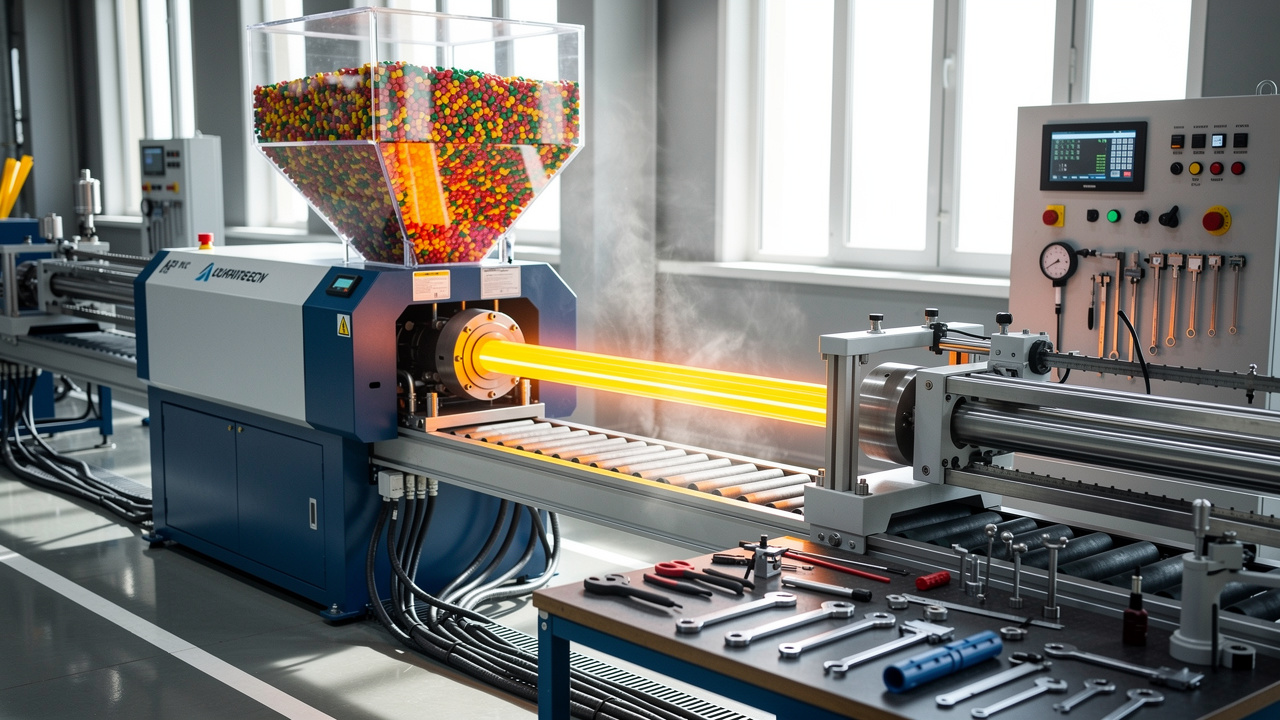
Initially, PVC resin, usually in pellet form, undergoes drying to eliminate moisture, which can greatly affect the standard of the final product. After this preparation, the resin enters a PVC profile extruder, where heat causes it to melt. The PVC profile extruder forces the molten PVC through a die, shaping it into the desired profile. Once shaped, the extrudate is cooled, often using water baths or air cooling systems, before being cut to the specified length.
To optimize this process, Lincoln Plastics employs crucial best practices that enhance efficiency and standards, ensuring consistent production outcomes. We take pride in our ISO 9001:2015 certification, which reflects our commitment to quality through stringent management plans, including specialized manuals and in-process inspections. Have you considered how each stage impacts your final product? Understanding these stages is essential for identifying areas of improvement and ensuring consistent quality in production.
Additionally, the company offers a range of value-added services, such as:
- Co-extrusion for multi-color or multi-material profiles
- Laser etching
- Specialized packaging solutions, tailored to meet the specific needs of OEMs
For expert guidance on custom pipe and tube design, material selection, and vendor-managed inventory solutions, we invite you to contact Lincoln Plastics for quotes or tailor-made solutions.

Select Optimal Equipment for Enhanced Performance
Selecting the right equipment for the PVC profile extruder can make or break your production efficiency. Key factors to consider include:
- The type of extruder - specifically single-screw versus twin-screw designs
- Die configuration
- Downstream equipment such as cooling systems and cutters
Twin-screw extruders are frequently preferred due to their excellent mixing abilities and capacity to manage a wider variety of materials. This greatly improves the quality of the extrudate. For instance, they provide better temperature control and energy efficiency, making them the industry standard for modern PVC pipe factories.
At Lincoln Plastics, we understand the importance of reliability in our extrusion processes. Our robust management program, certified to ISO 9001:2015, includes dedicated manuals for each plastic profile, documenting critical dimensions, in-process checks, and run documentation. We also utilize multiple types of check gauges to ensure a proper end-use fit, tailored to the specific needs of OEMs. This careful method guarantees that our items satisfy all standards, including specific assessments for fit and function.
Investing in advanced control systems is crucial. These systems allow for real-time monitoring and adjustments, resulting in more consistent output. The FDA process-validation guidance emphasizes the importance of ongoing data collection and statistical trending for maintaining control, which supports the need for these advanced systems. Regular maintenance of equipment cannot be overlooked; it is vital for preventing breakdowns and ensuring sustained optimal performance. Case studies, such as the GL Control Citris System, illustrate how precise recording of internal geometries can reduce unplanned downtime, demonstrating the benefits of prioritizing maintenance.
Are you struggling to find the right equipment that meets your production needs? By prioritizing these factors, you position your operation for success in the competitive landscape of the PVC profile extruder industry.

Implement Rigorous Quality Control Practices
To achieve unparalleled quality in PVC profiles, it is non-negotiable to implement stringent control measures in the PVC profile extruder. At Lincoln Plastics, we prioritize a robust assurance framework. This includes:
- Verifying raw materials
- Monitoring processes
- Testing final items thoroughly
Our assurance plan clearly outlines the organizational structure, roles, responsibilities, and processes required to meet quality standards. Techniques such as statistical process control (SPC) are invaluable for tracking production metrics and identifying variations that may signal potential issues.
Furthermore, we employ various check gauges to ensure an appropriate end-use fit and collaborate closely with OEMs to guarantee their items meet all standards, including special checks for 'fit and function.' Regular inspections of the extrudate produced by the PVC profile extruder are crucial, focusing on:
- Dimensional accuracy
- Surface finish
- Mechanical properties to ensure compliance with industry standards
For example, testing methods for raw materials and finished goods encompass evaluations for hardness, flexibility, and resistance to heat and chemicals.
Additionally, we can easily source colors that meet your Pantone specifications for consistency across manufacturers. Our strong assurance system includes a dedicated manual for your plastic profile with drawings, critical in-process checks, and run documentation. By fostering a culture of excellence within the production team and offering continuous training, Lincoln Plastics can significantly decrease defects and improve overall reliability.
This commitment to quality not only reduces defects but also enhances customer trust and loyalty. Ultimately, our unwavering commitment to quality translates into lasting partnerships and increased market success.

Embrace Continuous Improvement and Innovation
In the competitive landscape of the PVC profile extruder industry, continuous improvement is not just beneficial; it's essential for survival. Ongoing enhancement is crucial, where producers can utilize methodologies like Lean and Six Sigma to optimize processes, reduce waste, and elevate standards. Statistics show that more manufacturers are adopting these methodologies. Companies are seeing significant reductions in defect rates and operational costs. By regularly analyzing production data and gathering operator feedback, we can pinpoint key areas for improvement.
The company emphasizes rigorous management of standards through its ISO 9001:2015 certification, ensuring that all products meet stringent benchmarks. Their robust quality system includes dedicated quality books for each plastic profile, with detailed drawings, critical in-process checks, and run documentation. Additionally, the company uses various check gauges to guarantee a proper end-use fit. They can also source colors that meet Pantone specifications, ensuring consistency across manufacturers.
Lincoln Plastics fosters a culture of innovation and experimentation. This is crucial, especially given the ongoing shortage of skilled operators in the extrusion industry. Such an approach positions the company to adapt to changing market demands and enhance operational efficiency. By embracing innovation, Lincoln Plastics not only meets current demands but also anticipates future challenges, ensuring sustained success.

Conclusion
In the competitive landscape of PVC profile extrusion, optimizing processes is not just an option; it's a necessity for success. Understanding each stage - from material preparation to cutting - helps manufacturers identify improvement opportunities and boost efficiency. Lincoln Plastics shows its commitment to excellence with its ISO 9001:2015 certification, underscoring the importance of rigorous quality management practices and continuous improvement.
Key strategies discussed include:
- Selecting optimal equipment tailored to specific production needs
- Implementing stringent quality control measures
- Fostering a culture of innovation
The use of advanced control systems and methodologies like Lean and Six Sigma can significantly reduce waste and improve operational performance. Additionally, Lincoln Plastics' dedication to quality assurance, including detailed documentation and in-process checks, ensures that every product meets the highest standards.
In a rapidly evolving industry, without embracing these best practices, manufacturers risk falling behind. Companies are encouraged to prioritize quality and efficiency in their extrusion processes and consider partnering with experts like Lincoln Plastics for tailored solutions that meet their unique needs. By doing so, manufacturers can enhance their production capabilities and build lasting relationships with their customers, ultimately driving growth and success in the PVC profile market.
Frequently Asked Questions
What is the PVC profile extrusion process?
The PVC profile extrusion process involves several stages: material preparation, melting, shaping, cooling, and cutting. It begins with drying PVC resin to remove moisture, followed by melting the resin in a PVC profile extruder, shaping it through a die, cooling the extrudate, and finally cutting it to the desired length.
Why is moisture removal important in the PVC extrusion process?
Moisture removal is crucial because any moisture present in the PVC resin can significantly affect the quality of the final product.
What certifications does Lincoln Plastics hold related to quality management?
Lincoln Plastics is ISO 9001:2015 certified, which demonstrates their commitment to quality through rigorous management plans, including dedicated quality manuals and in-process inspections.
What best practices does Lincoln Plastics employ in the extrusion process?
Lincoln Plastics employs best practices that enhance efficiency and standards, ensuring consistent production outcomes throughout the PVC profile extrusion process.
What additional services does Lincoln Plastics offer?
Lincoln Plastics offers value-added services such as co-extrusion for multi-color or multi-material profiles, laser etching, and specialized packaging solutions tailored to meet the specific needs of OEMs.
How can I get expert guidance on custom pipe and tube design from Lincoln Plastics?
For expert guidance on custom pipe and tube design, material selection, and vendor-managed inventory solutions, you can contact Lincoln Plastics for quotes or tailor-made solutions.
List of Sources
- Understand the PVC Profile Extrusion Process
- Master the PVC Pipe Extrusion Process: Steps, Tools, and Solutions (https://lincoln-plastics.com/news-post/master-the-pvc-pipe-extrusion-process-steps-tools-and-solutions)
- PVC Extrusion Profile Market Analysis Report 2026-2033: Macro and Microeconomic Factors and Their Impact on the Projected CAGR of 12.2% (https://linkedin.com/pulse/pvc-extrusion-profile-market-analysis-report-2026-2033-macro-tsjre)
- Resin Drying in Plastic Extrusion: Moisture Defects, Dew Point and Drying Control (https://jfextruder.com/resin-drying-in-plastic-extrusion)
- The Extrusion Industry in 2026-2027: Innovations, Trends, and Opportunities (https://plextrusions.com/extrusion-blog/the-extrusion-industry-in-2026-2027-innovations-trends-and-opportunities)
- Plastics Extrusion: 4 Critical Statistics to Track for Increased Quality & Plant Profit (https://gaugeadvisor.com/plastics-extrusion-4-critical-statistics-to-track-for-increased-quality-plant-profit)
- Select Optimal Equipment for Enhanced Performance
- Twin-screw extruders outperform simpler single-screw machines - Responsible Seafood Advocate (https://globalseafood.org/advocate/twin-screw-extruders-outperform-simpler-single-screw-machines)
- 10 new extrusion technologies reshaping plastics processing in 2026 (https://plasticsmachinerymanufacturing.com/extrusion/article/55395844/10-new-extrusion-technologies-reshaping-plastics-processing-in-2026)
- Twin Screw vs Single Screw Extruder in PVC Pipe Production Lines - SHARC (https://sharcpm.com/news/twin-screw-vs-single-screw-extruder-in-pvc-pipe-production-lines)
- Plastics Extrusion: 4 Critical Statistics to Track for Increased Quality & Plant Profit (https://gaugeadvisor.com/plastics-extrusion-4-critical-statistics-to-track-for-increased-quality-plant-profit)
- Plastic Extrusion Machine Manufacturers Guide 2026 | JWELL (https://jwell.co/industry-news/top-plastic-extrusion-machine-manufacturers)
- Implement Rigorous Quality Control Practices
- Quality Control in Plastic Manufacturing: How to Improve Your QC Process for Optimum Results (https://pti.tech/2024/01/18/quality-control-in-plastic-manufacturing-how-to-improve-your-qc-process-for-optimum-results)
- 4 Best Practices for Effective Process Control Quality in Extrusion (https://lincoln-plastics.com/news-post/4-best-practices-for-effective-process-control-quality-in-extrusion)
- Quality Control and Testing Procedures - Plastic Extrusion Technologies (https://plasticextrusiontech.net/quality-control-and-testing-procedures-in-plastic-extrusions)
- The Importance of Quality Control in Plastic Manufacturing (https://plastekgroup.com/blog/the-importance-of-quality-control-in-plastic-manufacturing)
- Embrace Continuous Improvement and Innovation
- Plastics Manufacturing and Lean and Six Sigma Applications — ISSSP for Lean Six Sigma (https://isssp.org/plastics-manufacturing-and-lean-and-six-sigma-applications-isssp)
- PVC extrusion in transition: overcoming challenges and tapping potential (https://inoex.com/news/detail/pvc-extrusion-in-transition-overcoming-challenges-and-tapping-potential)
- The Extrusion Industry in 2026-2027: Innovations, Trends, and Opportunities (https://plextrusions.com/extrusion-blog/the-extrusion-industry-in-2026-2027-innovations-trends-and-opportunities)
- 10 new extrusion technologies reshaping plastics processing in 2026 (https://plasticsmachinerymanufacturing.com/extrusion/article/55395844/10-new-extrusion-technologies-reshaping-plastics-processing-in-2026)


