

What Are Chemical Resistant Polymers and Why They Matter in Manufacturing?
Introduction
Chemical resistant polymers are shaking things up in manufacturing! They tackle the ongoing issue of material degradation in tough environments. These innovative materials don’t just stand up to corrosive agents; they also boost efficiency across a bunch of industries, from pharmaceuticals to food production.
But here’s a thought: as the demand for these tough materials grows, how do you think the evolution of chemical resistant polymers will shape the future of manufacturing and sustainability? Let’s dive into that!
Define Chemical Resistant Polymers
Define Chemical Resistant Polymers
Have you ever faced the frustration of materials breaking down when exposed to harsh chemicals? It’s a common challenge, but there’s good news! Chemical resistant polymers are the materials here to save the day. These specialized materials are designed to handle tough environments without losing their strength or performance.
So, what exactly makes these materials so resilient? Well, they can withstand a variety of chemicals like acids, bases, solvents, and other corrosive substances. Their unique molecular structures - often characterized by high crystallinity or specific chemical bonds - help them maintain integrity even in challenging situations.
You might be wondering, what are some examples of these polymers? Let’s take a look at a few:
- Polytetrafluoroethylene (PTFE)
- Polyetheretherketone (PEEK)
- Polypropylene (PP)
Each of these materials has its own set of advantages, depending on what you need them for.
Next time you’re faced with a tough material challenge, remember that there are options out there that can stand up to the test!

Explore Applications and Importance in Manufacturing
You know, chemical resistant polymers play a huge role in various industries, particularly in processing, pharmaceuticals, and food production. Think about it: in chemical processing, polymers are used for piping, tanks, and valves that need to handle corrosive substances without breaking a sweat.
Now, in the pharmaceutical industry, equipment that deals with reactive substances absolutely requires chemical resistant materials. This ensures safety and keeps everything in line with regulations. And let’s not forget food production! Polymers are key in packaging and processing tools, helping to avoid contamination and keep product integrity intact.
What’s really cool is that these materials can withstand harsh environments, thereby boosting efficiency and extending the lifespan of equipment. This means lower maintenance costs and less downtime - who wouldn’t want that?
Looking at current trends, there’s a growing demand for these substances, especially in pharmaceuticals. With advancements in formulation techniques, we’re seeing improvements in efficacy and sustainability, particularly in drug delivery systems and sterile packaging. Companies like Sumitomo Chemical are even aiming for customer certification for bio-based liquid crystal materials by the end of fiscal 2026. It’s clear that sustainability is becoming a big deal.
And let’s not overlook the initiatives that are focused on cutting down greenhouse gas emissions and using non-fossil resources. These efforts are vital for building a sustainable society. Industry experts, like Eren Cetinkaya, point out the exciting potential for real-time optimization in manufacturing processes, which can really enhance the operational benefits of these resources. So, what do you think? Isn’t it fascinating how these materials are shaping the future?

Trace the Evolution of Chemical Resistant Polymers
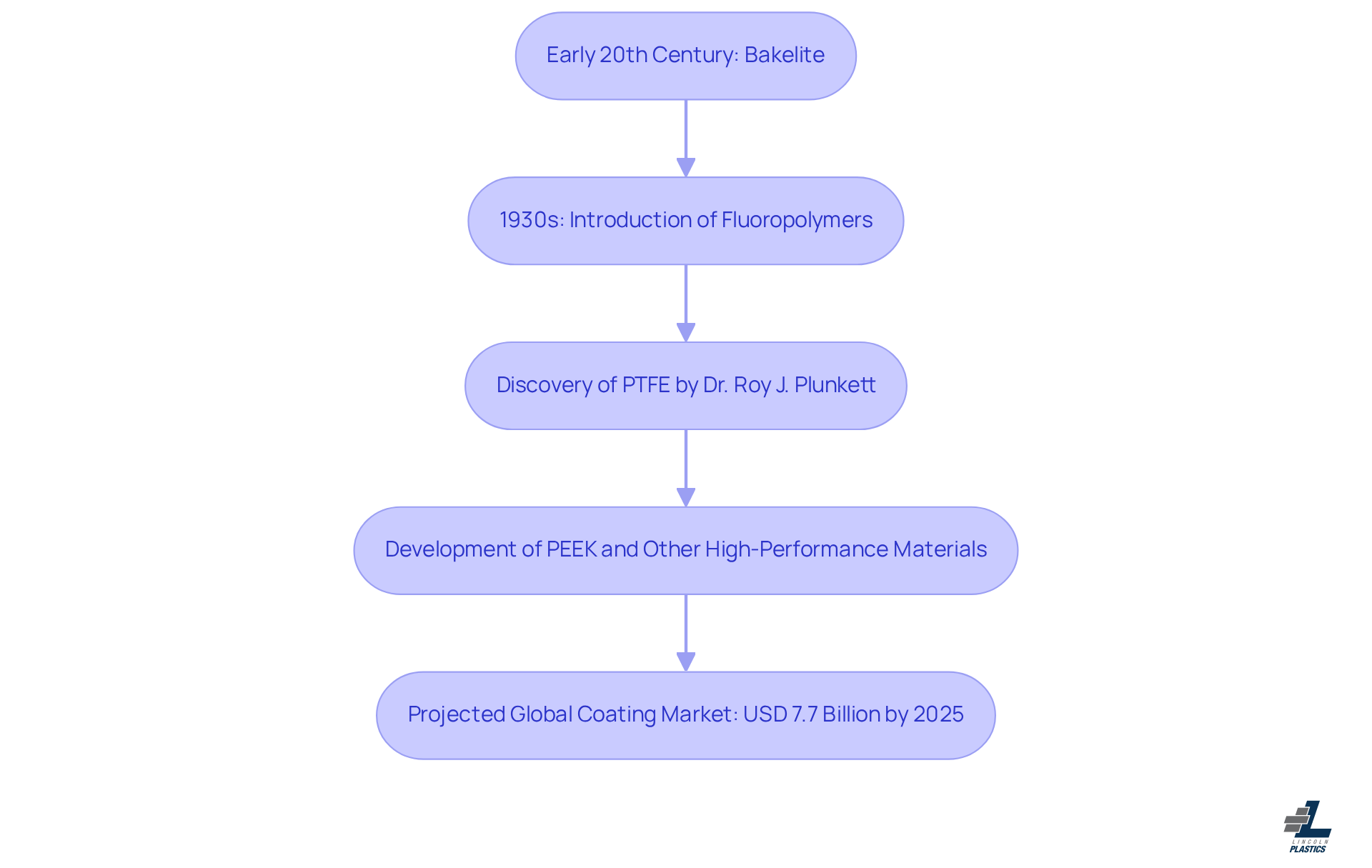
You know, the journey of resistant plastics actually kicks off in the early 20th century with Bakelite, which was the very first synthetic material. As folks started craving more options, the advancement in polymer chemistry led to the creation of new materials, giving us a variety of applications. Remember the 1930s? That’s when synthetic rubbers made their debut, marking a big milestone with their amazing resistance to substances and thermal stability.
Dr. Roy J. Plunkett had quite the discovery when he noticed that a sample had spontaneously turned into a white, waxy solid, leading to the invention of Teflon. Isn’t that fascinating? Over the years, we’ve seen innovations like PEEK and other high-performance polymers that have really expanded what durable materials can do, making them suitable for tougher challenges.
Now, here’s something to think about: the market for chemical resistant polymers is expected to hit a whopping USD 7.7 billion by 2025, with a growth rate of 3.7% CAGR from 2025 to 2035. Pretty impressive, right? And the best part? Research is still ongoing, focusing on new formulations to improve their resistance to a wider range of chemicals and environmental conditions. This just goes to show how crucial they are in manufacturing!
Identify Key Characteristics and Properties
When it comes to manufacturing, chemical resistant polymers really stand out, don’t they? They’ve got some key traits that make them super effective. For starters, they usually have high tensile strength, which means they can handle a lot of stress without breaking a sweat. Plus, their low permeability to gases and liquids is a big deal. It keeps harmful substances from seeping in and messing with their structural integrity.
Now, let’s talk about what happens when these materials face aggressive substances. High-quality options are designed to withstand harsh chemicals, showing minimal swelling or deterioration. This is crucial for keeping their performance intact over time. And guess what? Many of these materials even have self-lubricating properties. This helps reduce friction and wear in important applications like seals and bearings, which not only extends the lifespan of components but also improves efficiency.
But wait, there’s more! The impressive versatility of these polymers is noteworthy. They can perform well across a wide range of temperatures, making them perfect for tough environments. For manufacturers, understanding the properties of these materials is essential. It helps in selecting the right options for specific applications, ensuring that products perform optimally and last longer. So, next time you’re choosing materials, keep these traits in mind!

Conclusion
Chemical resistant polymers are pretty essential in various manufacturing sectors, right? These specialized materials are designed to handle tough environments, ensuring they last and perform well in everything from pharmaceuticals to food production. Their knack for resisting corrosive agents while keeping their mechanical integrity makes them a must-have in modern manufacturing processes.
Now, let’s talk about some key points. Chemical resistant polymers boast unique properties like:
- High tensile strength
- Low permeability
- Self-lubricating characteristics
These features not only help equipment last longer but also boost operational efficiency and save costs. Plus, with ongoing advancements in polymer chemistry and the rising demand for sustainable materials, these polymers are becoming even more important in meeting industry needs.
In conclusion, we can’t overlook the significance of chemical resistant polymers. As industries evolve and face new challenges, the reliance on these tough materials is only going to grow. By embracing innovative solutions and understanding what makes chemical resistant polymers tick, manufacturers can optimize their processes, cut down on maintenance costs, and ultimately push towards a more sustainable future. So, what do you think? Ready to dive deeper into the world of chemical resistant polymers?
Frequently Asked Questions
What are chemical resistant polymers?
Chemical resistant polymers are specialized materials designed to withstand harsh environments without losing their strength or performance, particularly when exposed to reactive agents like acids, bases, and solvents.
What makes chemical resistant polymers resilient?
Their resilience comes from unique molecular structures, often characterized by high crystallinity or specific bonds, which help them maintain their integrity in challenging situations.
Can you provide examples of chemical resistant polymers?
Yes, examples of chemical resistant polymers include Polytetrafluoroethylene (PTFE), Polyetheretherketone (PEEK), and Polypropylene (PP).
What are the advantages of using different chemical resistant polymers?
Each chemical resistant polymer has its own set of advantages depending on the specific application or environment in which it is used.
List of Sources
- Define Chemical Resistant Polymers
- osborneindustries.com (https://osborneindustries.com/news/top-acid-resistant-plastics)
- fiberopticsystems.com (https://fiberopticsystems.com/boosting-chemical-resistance-properties-with-cutting-edge-polymer-engineering)
- The History of Teflon™ Fluoropolymers (https://teflon.com/en/news-events/history)
- sabic.com (https://sabic.com/en/news/41068-sabic-expands-chemically-resistant-lnp-crx-copolymer-portfolio-to-help-industrial-and-mobility-customers-design-for-durability)
- Explore Applications and Importance in Manufacturing
- chemistryworld.com (https://chemistryworld.com/news/chemicals-industry-roundup-2025/4022541.article)
- sumitomo-chem.co.jp (https://sumitomo-chem.co.jp/english/news/detail/20250612e.html)
- mqplastics.com (https://mqplastics.com/future-of-nylon-films-2026)
- dupont.com (https://dupont.com/news/dupont-introduces-dupont-amberlite-fpa57-resin-to-boost-efficiency-in-organic-acid-purification.html)
- braskem.com.br (https://braskem.com.br/europe/news-detail/braskem-expands-additive-manufacturing-portfolio-with-polyethylene-and-glass-fiber-reinforced-polypropylene-3d-printing-filaments)
- Trace the Evolution of Chemical Resistant Polymers
- futuremarketinsights.com (https://futuremarketinsights.com/reports/chemical-resistant-coating-market)
- The History of Teflon™ Fluoropolymers (https://teflon.com/en/news-events/history)
- In major materials breakthrough, team solves a nearly 200-year-old challenge in polymers (https://sciencedaily.com/releases/2024/11/241127165734.htm)
- yonghe-chemical.com (https://yonghe-chemical.com/the-evolution-of-fluoropolymers-from-accidental-discovery-to-a-family-of-plastic-royals)
- Identify Key Characteristics and Properties
- sciencedaily.com (https://sciencedaily.com/releases/2024/10/241007115309.htm)
- en.wotlon.com (https://en.wotlon.com/Blog_details/1898589698123452416.html)
- en.wotlon.com (https://en.wotlon.com/Blog_details/2014543615108284416.html)
- CHEMICAL RESISTANT PLASTICS: AN EXPERT GUIDE TO MATERIAL SELECTION FOR PRECISION PARTS – AIP Precision Machining (https://aipprecision.com/chemical-resistant-plastics-an-expert-guide-to-material-selection-for-precision-parts)
Related posts

Plastic Extrusion for Energy & Infrastructure Projects
Lincoln Plastics provides durable, custom extrusion solutions for energy and infrastructure projects, from conduit to tubing to protective profiles.


Made in the Midwest: Why Location Matters
Lincoln Plastics’ Midwest location provides faster shipping, lower freight costs, and the reliability OEMs need in a manufacturing partner.
How Extrusion Supports OEM Supply Chains
Lincoln Plastics helps OEMs strengthen supply chains with flexible production runs, reliable delivery, and custom extrusion solutions.
