

Make the sourcing decision before requesting a quote
Tubing extrusion produces long, continuous products with a generally constant cross section. The process converts thermoplastic material into an annular product by melting it, forcing it through a die, cooling the formed tube, and drawing it away at a controlled rate. That continuous format differs from a cyclic process that produces separate molded parts.
Your first sourcing decision is therefore not simply whether a supplier can make a tube. You need to decide whether your application can be expressed through requirements that a supplier can manufacture, inspect, quote, and validate. A useful decision path connects five questions:
- What must the tube do in the finished assembly?
- Which dimensions, wall features, and tolerances control fit or function?
- Which quality checks must demonstrate conformance?
- How will prototypes, production volume, and delivery be managed?
- What information must appear in the RFQ so quotations can be compared fairly?
A purchasing evaluation should consider material direction, manufacturing capability, tolerances, production method, engineering support, quality consistency, delivery reliability, and scalability. Price matters, but a low unit quote does not answer whether the tube will fit the assembly, pass required testing, or remain available at production volume. Use the RFQ to expose those questions before you compare supplier totals.
Customizing plastic extrusion tubing is often necessary for OEM applications. The practical boundary is clear: a general guide can help you prepare the requirement, but application-specific suitability still requires engineering review, testing, or regulatory review where the application calls for it.
Use the sections that follow as a decision record rather than as a generic request for pricing. If you cannot yet describe the application, critical dimensions, expected volume, inspection needs, and delivery conditions, your next action is to complete that information before asking suppliers to make a production commitment.
Understand what the extrusion process must accomplish
Tube extrusion is a steady-state manufacturing process that turns thermoplastic pellets or powder into a continuous annular product. The extruder forms a homogeneous molten mass, pressure pushes the material through an opening in the extrusion die, and the emerging tube is cooled and drawn away at a controlled rate. After forming, the tube can be wound, cut to a specified length, or sent into another in-line operation.
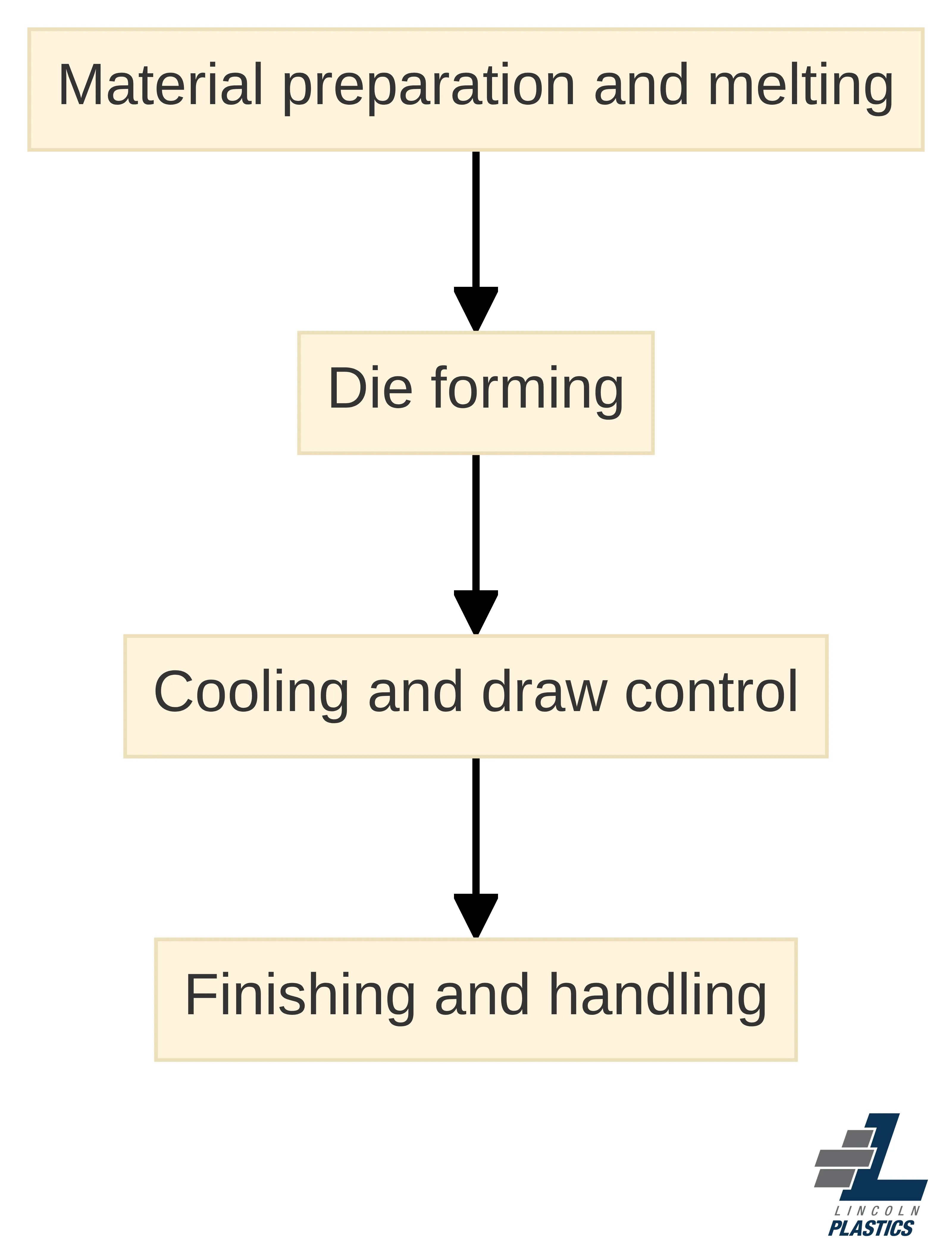
The process has four practical stages for your sourcing review:
- Material preparation and melting: Thermoplastic feedstock is converted into a homogeneous melt.
- Die forming: Pressure moves the melt through an opening that defines the tube cross section.
- Cooling and draw control: The formed tube is cooled while being pulled away at a controlled rate.
- Finishing and handling: The output is wound, cut, or directed to another continuous operation.
This sequence explains why the RFQ must describe more than outside diameter and length. The tube’s final dimensions depend on the relationship between material behavior, die geometry, processing conditions, cooling, and draw. Your supplier needs to know which dimensions are functional, how the tube will be handled after extrusion, and whether the finished form is cut, coiled, or processed further.
For your internal review, record which stage could create a meaningful acceptance risk. A wall-thickness requirement may depend on die and flow control, a length requirement may depend on cutting, and a coiled product may have handling or packaging conditions that do not apply to straight-cut pieces. This mapping gives your RFQ a practical link between each requirement and the production stage that must address it.
Continuous extrusion produces long products with a cross section that is usually constant along the production direction. That format can support high output rates and may reduce unit cost or secondary operations, but the commercial result depends on the application and the supplier quotation. Do not turn a process possibility into a savings assumption.
For your sourcing decision, ask whether the requirement is genuinely continuous. A tube that must maintain a repeated cross section over a defined length is a natural candidate for extrusion review. A requirement centered on discrete three-dimensional features, changing sections, or operations outside the continuous line may need a different manufacturing discussion or a combination of processes. Keep that boundary visible in your RFQ rather than assuming that a tube label determines the process.
Before requesting prices, document the expected production form: continuous coil, cut lengths, or an additional in-line operation. State whether the supplier should quote one form or several alternatives. This prevents a supplier from making a reasonable but different assumption about how the product will leave the line and lets you compare quotations on the same basis.
Treat the die and geometry as sourcing requirements
The extrusion die shapes the molten polymer and influences tube shape, wall-thickness uniformity, flow consistency, and surface quality. A quotation that lists only a material and an outside diameter leaves out the geometry and tooling questions that affect manufacturability.
Describe the cross section in a way that allows suppliers to review it. Include the following where they apply:
- Outside dimensions and internal dimensions.
- Nominal wall thickness and any locations with different wall requirements.
- Roundness, concentricity, or other geometric relationships that affect fit.
- Openings, grooves, ribs, channels, or other features in the profile.
- Required length, cut condition, coil condition, or downstream handling.
- A drawing, CAD file, marked-up sample, or dimensional sketch.
Extrusions can use open or enclosed geometries. Some enclosed extrusion profiles are described with up to four lumens, while open forms can include U, J, or L channels, showing why the phrase “plastic tube” may not fully describe the part. State whether your design is a simple annulus or a more complex profile, and identify the internal spaces or features that carry a functional requirement.
Profile complexity affects tolerance requirements: simpler profiles may allow wider allowances, while intricate shapes may require tighter specifications for fit and function. Processing variables also matter. Melt temperature, shaping speed, and cooling rates can affect extrusion tolerance control, while the die influences flow and the resulting surface.
Ask the supplier to separate three decisions in the quote:
- Which geometry the proposed tooling will produce.
- Which dimensions the supplier will treat as critical-to-function.
- Which inspection method will demonstrate those dimensions during production.
This separation helps you distinguish a tool proposal from a quality plan. It also gives your engineering team a clear point for reviewing whether the proposed cross section and tolerance scheme match the assembly.
Request that the supplier identify any geometry that requires a special tooling feature, a process adjustment, or a secondary operation. Keep those items beside the related drawing dimension rather than burying them in general quotation notes. The result is a technical record that shows what the quoted tooling is expected to accomplish.
Define the application before discussing resin or tolerance
The application requirement should come before the resin name or tolerance number. Material selection affects shrink rates, flow characteristics, and dimensional stability, while profile complexity and processing conditions affect the tolerance discussion. A material label by itself does not establish suitability for your environment or assembly.
Start your application brief with the conditions the tube must face:
- What does the tube connect to, contain, protect, guide, or separate?
- Does the tube carry a fluid, protect a cable, guide a component, or form part of an OEM machine?
- What temperatures, chemicals, loads, abrasion, moisture, sunlight, or cleaning conditions apply?
- Will the tube be flexed, compressed, clamped, cut, coiled, or assembled repeatedly?
- Which dimensions control a seal, connection, clearance, routing path, or installation step?
- What service life, inspection, traceability, or documentation expectations apply?
Those answers give the supplier and your engineering team a basis for discussing manufacturing. They do not replace material qualification or application testing. If the application has a regulated, safety-related, pressure-related, or otherwise consequential requirement, identify that requirement before requesting a production quote.
Turn the answers into a condition table with four columns: operating condition, affected tube feature, required evidence, and responsible approval function. For example, a connection requirement can point to a critical dimension and an assembly check, while an environmental requirement can point to a material review or application test. This format keeps technical questions connected to the decision they are meant to support.
Before sending the RFQ, mark each row as confirmed, estimated, or requiring testing or supplier review. That status prevents an estimated operating condition from being mistaken for an approved design input. It also tells the supplier where a quotation should include an assumption rather than silently selecting a material, tolerance, or inspection method. During review, close the rows that control fit, function, or compliance first, and keep lower-consequence descriptive details separate from release-blocking requirements.
An OEM tubing requirement may need customization because the finished part has to serve a particular application. A specification that applies to a defined product category may also include its own dimensions, performance tests, markings, inspection conditions, or quality-control requirements. For example, ASTM F679 covers specific PVC large-diameter gravity sewer pipe and fittings and includes dimensions, flattening resistance, impact resistance, pipe stiffness, joint tightness, extrusion quality, markings, and quality-control testing.
Do not copy those requirements into an unrelated tube specification. Instead, identify the standard, regulation, customer requirement, or internal test method that actually governs your product, then ask the supplier how the quotation and validation plan will address it. Application-specific engineering and regulatory review decide whether a requirement applies.
Separate material direction from manufacturing guidance
Material direction and manufacturing guidance are separate responsibilities in an OEM sourcing process. You or your resin supplier may define the candidate resin or grade based on the application, while the extrusion supplier evaluates how that material and design can be processed into the required tube. This division keeps a manufacturing recommendation from becoming an unsupported declaration of application suitability.
Give the supplier the material information you already have:
- Resin family and grade, if specified.
- Approved alternatives or prohibited substitutions.
- Color, additive, filler, or reinforcement requirements, if applicable.
- Required documentation, lot controls, or traceability.
- Any prior test data or approved material list.
Then ask for manufacturing feedback on melt behavior, shrinkage, flow, cooling, tooling, processing windows, surface condition, and expected dimensional control. Material selection can affect shrink rates, flow characteristics, and dimensional stability, so the manufacturing review should connect the proposed resin to the tube geometry and process rather than treating those decisions independently.
At Lincoln Plastics, we provide custom plastic extrusion tubing for OEMs, including irrigation and cord covers. Those first-party capabilities establish a reason to include Lincoln Plastics in an RFQ for a custom tubing requirement; they do not establish that a particular resin, tolerance, or design will suit your application.
Ask manufacturing questions that keep the boundary clear:
- Can you review the drawing for manufacturability?
- Which dimensions should be identified as critical?
- What tooling or process considerations could affect the proposed design?
- What information would you need before recommending a production route?
Use the answers to refine the technical record. Keep final material approval and application suitability with the functions responsible for those decisions.
Set tolerances around fit and function
A tolerance should describe a functional requirement, not simply a number copied from another drawing. Profile complexity affects achievable tolerance requirements, and material properties, processing conditions, cooling, tooling, and cutting methods can influence the result. Start by identifying what must fit, seal, move, connect, clear, or remain stable in the finished assembly.
Divide dimensions into three groups:
- Critical dimensions: A variation could prevent assembly, affect a seal, change a connection, or alter a required function.
- Controlled dimensions: A variation matters to appearance, handling, or a downstream operation but does not directly determine the primary function.
- Reference dimensions: These describe the design without creating an independent acceptance requirement.
Show the tolerance beside the dimension it controls, and explain the function in the RFQ. Ask the supplier to identify any tolerance that may require special tooling, additional process control, a secondary cut, or a different inspection method. That discussion lets you evaluate cost and feasibility together rather than demanding tight limits without understanding their purpose.
A supplier guideline cites ±1/16 inch as a typical extrusion length tolerance, while noting that actual tolerance varies with material, profile design, cutting method, and length. The same guidance notes that length tolerance may increase for longer lengths. Treat that figure as an attributed example, not as a universal specification for your tube.
Overly stringent tolerances can increase tooling costs, setup time, and scrap rates. Your purchasing record should therefore ask for two responses when a tight tolerance is necessary:
- What process and inspection method will control the requirement?
- What commercial or production effect follows from that requirement?
If a tolerance is not tied to fit or function, reconsider whether it belongs in the acceptance criteria. If it is tied to fit or function, retain it and require the supplier to address how it will be measured.
Build the RFQ around a complete technical record
A useful tubing extrusion RFQ gives each supplier the same technical and commercial starting point. The record should let the supplier understand the application, review manufacturability, identify assumptions, price tooling and production, and describe how conformance will be demonstrated.
Include these sections in the RFQ package:
- Part identity: Part name, revision, drawing number, and intended assembly.
- Application: Function, mating components, installation method, service environment, and consequences of nonconformance.
- Geometry: Cross-section drawing or CAD file, inside and outside dimensions, wall requirements, profile features, length, and cut or coil condition.
- Material direction: Resin family or approved grade, color, additives, alternatives, and required documentation.
- Tolerances: Critical dimensions, functional explanation, general tolerances, and any inspection definition.
- Quality: Required certificates, inspection records, test methods, sampling expectations, traceability, markings, and packaging condition.
- Volume: Prototype quantity, launch quantity, annual demand, order pattern, forecast assumptions, and expected production horizon.
- Commercial response: Tooling, piece price, setup, minimum order quantities, packaging, freight basis, payment terms, quotation validity, and lead-time assumptions.
A complete record does not require you to know every manufacturing answer before contacting a supplier. It does require you to label open decisions clearly so a quotation does not hide them inside an unstated assumption.
Ask suppliers to return their response in the same order as your RFQ. Require each exception, assumption, and excluded item to appear in a dedicated section. A standard response format makes it easier to distinguish a supplier’s confirmed capability from a condition that still requires engineering or commercial review.
The process description should connect the requested part to the production route. State whether the tube will be wound, cut to specified lengths, or sent to another in-line operation. Identify whether the drawing contains a simple annular section or a more complex profile, because geometry affects die design, flow, cooling, and tolerance review.
Before releasing the RFQ, complete this short internal check:
- The drawing identifies the dimensions that control assembly.
- The material direction identifies what is approved and what remains open.
- The volume forecast separates prototypes from production demand.
- The inspection request names the characteristics that must be demonstrated.
- The commercial request asks suppliers to separate tooling, piece price, logistics, and assumptions.
Send the same record to each candidate supplier. Comparable inputs produce more useful comparisons than a collection of informal conversations.
Add an assumptions register to the package. For every unresolved item, name the assumption, the quotation element it affects, the evidence needed to close it, and the approval owner. Use the register to distinguish a supplier's included scope from an optional service or a customer decision that has not been made. This is particularly useful when tooling, material release, inspection level, volume, packaging, or delivery trigger remains conditional. Update the register after clarification so the comparison reflects the same technical record that supports the purchase decision.
Ask how quality will be demonstrated
Supplier quality should be evaluated through the practices and records that demonstrate conformance, not through a general statement that quality is controlled. Ask what the supplier will inspect, how often the checks occur, which instruments or methods are used, and what happens when a result falls outside the requirement.
Possible questions include:
- How will critical dimensions and wall features be inspected?
- How will surface condition be assessed?
- Which process variables are monitored during production?
- Is statistical process control used for any defined characteristics?
- How are potential failure modes reviewed before production?
- How are root causes documented and corrective actions followed through?
- Are automated inspections used, and if so, for which characteristics?
- What records will accompany the first article, pilot run, or production shipment?
Dimensional inspection, surface inspection, statistical process control, failure mode and effects analysis, root-cause analysis, and automated inspection are practices you can ask suppliers to describe. These are options for supplier comparison, not universal requirements. Match the request to your product risk and specification.
Also ask how inspection results will be tied to the part revision and production lot. A measurement record is more useful when you can identify the drawing revision, material lot, production date, sampled quantity, acceptance rule, and disposition of any nonconforming result. Include those record expectations in the RFQ rather than adding them after the quotation.
At Lincoln Plastics, we are certified to the ISO 9001 standard. That first-party fact is relevant to supplier qualification, but certification alone does not answer every product-specific inspection question. Your RFQ should still identify the characteristics, tests, records, and acceptance criteria required for the tube.
Ask each supplier to distinguish its management-system certification from the controls proposed for your part. Request a quality plan or inspection outline that names the critical dimensions, sampling approach, nonconformance process, traceability expectations, and any customer-specific documentation. Keep the request tied to the drawing and application so the quality discussion remains measurable.
Compare prototype, scale-up, and delivery risk
Prototype approval and production readiness are separate decisions. Treat an acceptable first sample as one input to the production-readiness decision, not as the sole basis for closing production questions.
Ask suppliers to describe the path between these stages:
- Drawing and material review.
- Tooling design or modification.
- Initial sample or prototype run.
- Dimensional and application review.
- Process adjustments and approval records.
- Pilot or launch production.
- Ongoing production controls and shipment release.
For each stage, assign an owner, required input, approval evidence, and decision date inside your project plan. The supplier can explain its manufacturing sequence, but your team must decide which sample results authorize the next stage.
Set a release gate between prototype approval and production ordering. The gate should identify the approved drawing revision, material direction, accepted sample results, open deviations, quality documentation, packaging requirements, and commercial conditions. If any item remains open, record who may approve it and whether the supplier’s price or delivery assumption changes.
Production scalability and delivery reliability belong in the same comparison as quality. Ask for the proposed production method, capacity assumptions, order pattern, minimum quantities, packaging format, replenishment expectations, and any constraints that could affect delivery. Ask how a forecast becomes a scheduled order, and identify which dates are quoted versus which dates depend on your approval or material release.
At Lincoln Plastics, we provide tailored OEM extrusion solutions including pipes, tubes, and flexible profiles. That capability is relevant when you are evaluating a custom tubing source, but the RFQ still needs your volume, launch timing, packaging, and delivery requirements before a supplier can respond to the commercial risk. Compare delivery conditions on the same basis. Record whether the quoted timing begins after drawing approval, tooling release, material release, or purchase-order receipt. Then identify the event that could move the date and the party responsible for that event. This records the conditions behind the quoted timing.
Evaluate total landed cost instead of unit price alone
Total landed cost is a comparison method that puts the quoted unit price beside the costs and conditions required to receive an acceptable tube. Continuous extrusion can support high output rates and may reduce unit costs or secondary operations, but actual savings depend on the application and supplier quotation. Compare the full commercial record rather than assuming that process efficiency will produce a fixed saving.
Request separate line items for:
- Tooling design, fabrication, modification, and maintenance assumptions.
- Prototype, setup, sampling, and first-article charges.
- Production unit price at each stated volume.
- Minimum order quantity and any lot-size effect.
- Cutting, coiling, packaging, labeling, and documentation.
- Freight basis and any applicable customs, handling, or delivery charges.
- Scrap, rework, inspection, or special testing charges where applicable.
- Quote validity, escalation assumptions, payment terms, and release conditions.
Use the same volume, packaging, delivery point, and acceptance requirements for every quotation. A unit-price comparison is not meaningful when one supplier has included tooling or freight and another has excluded it.
Normalize the comparison before making a recommendation. Convert each quotation to the same annual volume, delivery point, packaging condition, currency, and acceptance basis. Keep one-time costs separate from recurring costs, and show which assumptions would change the result. This gives you a commercial range rather than a misleading single number.
Tolerance choices can change the commercial picture. Overly stringent tolerances can increase tooling costs, setup time, and scrap rates, while material, profile complexity, and processing conditions affect tolerance control. A lower initial unit price may therefore be offset by additional inspection, rejected parts, secondary cutting, or a design revision if the requirement was not defined correctly.
Ask each supplier to identify the cost drivers that are directly tied to your requirements. Then distinguish a cost reduction from a requirement change. Removing a tolerance that protects assembly function is not a saving; it is a different part specification that requires engineering approval.
Review cost sensitivity for the requirements most likely to change the quote: tooling complexity, tight dimensions, cut length, production volume, packaging, inspection, and delivery conditions. Ask what happens to total cost if the volume changes or if a proposed tolerance is widened after functional review. Keep those scenarios separate from the approved production quotation.
Separate supplier evidence from application validation
Supplier evidence can show how a tube will be made and inspected, but supplier evidence does not by itself prove that the tube is suitable for your finished product. Keep three questions separate:
- Can the supplier manufacture the stated geometry and material direction? Review tooling, process, dimensional capability, surface controls, and production method.
- Can the supplier demonstrate conformance to the drawing and quality plan? Review inspection methods, test records, traceability, nonconformance handling, and sample results.
- Will the finished tube work in your application? Review assembly fit, service conditions, performance testing, regulatory obligations, and customer requirements.
For applications governed by a defined standard, identify the exact scope before using its requirements. ASTM F679, for example, addresses a specific category of PVC large-diameter gravity sewer pipe and fittings and includes product requirements and test methods. That does not make it a general specification for every extruded tube.
Application-specific engineering, testing, and regulatory review determine the final suitability decision. Record which function owns each approval so a purchasing selection does not substitute for technical validation.
Those facts can support an initial supplier screen. They do not remove the need for your drawing review, sample approval, testing, or regulatory assessment where those steps apply.
Use a simple evidence boundary in your sourcing file:
- Supplier statement: What the supplier says it can provide.
- Documented control: What the supplier can show through a quality plan, inspection record, certificate, or sample result.
- Application approval: What your engineering, quality, regulatory, or customer process accepts for the finished product.
Advance a supplier only when the evidence matches the requirement and the responsible function has approved the applicable stage.
Use a supplier-comparison record to make the recommendation
A supplier-comparison record turns several quotations into a documented recommendation. Use one row or section for each candidate and record the same fields for each response. Avoid giving a supplier credit for an answer that is merely implied, and mark unanswered questions rather than filling them with assumptions.
Capture these fields:
- Technical fit: geometry, material direction, tooling approach, and stated manufacturing assumptions.
- Tolerance response: critical dimensions, proposed capability, inspection method, and unresolved questions.
- Quality evidence: certification, inspection plan, process controls, test records, traceability, and nonconformance process.
- Development path: prototype timing, sample approval, pilot production, and launch conditions.
- Production scale: volume assumptions, minimum quantities, order pattern, capacity conditions, and continuity plan.
- Delivery: quoted lead time, release requirements, packaging, freight basis, and delivery conditions.
- Commercial total: tooling, piece price, setup, testing, packaging, freight, and other stated charges.
- Application validation: tests, standards, customer approvals, or engineering reviews still required.
Use statuses such as confirmed, quoted with conditions, open question, or requires validation. Those labels make uncertainty visible without turning an incomplete answer into a negative judgment.
Keep technical, quality, delivery, and commercial statuses separate. A supplier can have a confirmed tooling approach while still having an open application test or a conditional delivery date. Separate statuses prevent strength in one category from being treated as proof in another.
Your recommendation should explain why the selected sourcing path matches the requirement and what remains open. A concise recommendation can follow this order:
- State the application and the tube characteristics that control the decision.
- Identify the supplier response that addresses geometry, material, quality, production, and delivery.
- Show the commercial assumptions behind the total landed cost.
- List unresolved technical, regulatory, or application-validation items.
- Define the approval required before production release.
Do not rank suppliers by price until the quotations describe comparable tolerances, inspection, volume, packaging, and delivery conditions. A tight tolerance can carry tooling, setup, and scrap consequences, so the recommendation should explain whether each tolerance is functionally required and commercially addressed. The result should be a conditional sourcing decision: proceed to technical validation, request clarification, revise the design, or keep the supplier under review.
If you use a scorecard, define what each status means before reviewing supplier responses. A confirmed answer should point to a stated capability or document; a conditional answer should identify its trigger; open should mean information is missing; and requires validation should mean the supplier response cannot replace internal approval. Keep required requirements separate from preferences. A supplier that does not address a required geometry or validation item should not offset that gap with a lower price unless the requirement itself is formally changed and approved. This keeps the recommendation aligned with the application rather than scoring convenience.
Prepare the next action with Lincoln Plastics
Your tubing extrusion decision is ready for supplier discussion when the application, cross section, material direction, critical tolerances, quality requirements, volume, delivery conditions, and commercial assumptions appear in one record. Include the drawing, expected quantities, intended use, required documentation, and the questions that remain open.
Keep final suitability with the functions responsible for engineering, testing, quality, and regulatory review. A complete RFQ will give those teams and the supplier a clearer basis for the next technical and commercial decision.


