

Separate the Company Name from the Sourcing Question
The phrase fabricated extrusion company can describe a search goal, a supplier category, or the name of a particular business. Those are different questions. If you intended to find an organization whose legal or trading name is Fabricated Extrusion Company, do not treat Lincoln Plastics as that organization without separate identity confirmation.
If your actual need is an extruded plastic pipe or tube for agricultural equipment or an OEM product, the more useful question is whether Lincoln Plastics fits the application. That screen has two parts: identify what the supplier can provide, then match the documented offering to the requirements your component must meet.
This distinction keeps a name search from becoming an unsupported supplier recommendation. It also gives you a practical path forward when the search term is broader than the project brief.
Lincoln Plastics is documented as a provider of custom plastic extrusion tubing for OEM applications, including irrigation, and as a provider of tailored solutions that include pipes, tubes, and flexible profiles. Those facts make the business relevant to an initial sourcing screen, not automatically suitable for every pipe or tube requirement.
Use the rest of this guide to answer three practical questions:
- Does your component belong in a continuous extrusion conversation?
- Can the supplier review the dimensions, material direction, exposure, and fit requirements you provide?
- Which technical, quality, commercial, and identity details still require direct confirmation?
The result should be a consideration decision, not an engineering approval or a promise about price, capacity, lead time, compliance, or performance.
What an Extrusion Supplier Can Provide
An extrusion supplier can form continuous plastic products by feeding thermoplastic or other raw materials into an extruder and shaping the material through tooling. The process can produce single-extruded products, tubing, co-extruded products, and custom plastic profiles.
For a pipe or tube project, that means the conversation can cover more than a catalog diameter. You may need to discuss a round tube, a hollow pipe, a flexible tube, a rigid tube, or a profile whose shape is defined by how it interfaces with other equipment. The supplier’s role is to review the requested form and production considerations; your project team still needs to define what the finished component must do.
A useful first distinction is whether you need a standard form or a custom form. Standard tubing may provide a starting point when the diameter, wall, length, material direction, and interface already align with the equipment. Custom extrusion becomes relevant when the geometry, material arrangement, color, length, or fit must be developed around an OEM assembly. The available evidence establishes that OEMs often need customized extrusion tubing rather than only standard tubing, but it does not establish that every custom request is manufacturable without a project review.
A fabricated extrusion supplier may contribute to several stages of a pipe or tube sourcing discussion:
- Review the application and dimensional requirements.
- Discuss whether the requested form is standard tubing, custom tubing, pipe, or another extruded profile.
- Review material direction supplied by your team or recommended by the resin supplier.
- Consider tooling and process requirements associated with the requested geometry.
- Discuss whether the product needs a single material or a co-extruded arrangement.
- Prepare a quotation or technical response after the project information is clear.
Lincoln Plastics offers advice on the design of plastic extrusion tubing and custom pipes. Lincoln Plastics also provides custom plastic extrusion tubing for OEMs in applications that include irrigation. Those are relevant reasons to begin a supplier discussion; they are not evidence that a particular diameter, wall thickness, resin, tolerance, exposure requirement, or production quantity has already been approved.
Standard and custom extrusion solve different sourcing problems. A standard component may reduce design work when its geometry and material satisfy the equipment interface. A custom component may be appropriate when the part must match an OEM assembly or combine requirements that an off-the-shelf tube does not address.
The process category does not answer the fit question by itself. PVC, polyethylene, and polypropylene have different properties that influence their behavior during extrusion, so a material name alone is not enough to establish suitability. Keep the extrusion discussion, the application requirements, and the material review connected from the beginning.
Why the Component Determines the Supplier Screen
The component determines which supplier questions matter. A tube used as a protected sleeve may require a different review from a pipe that carries fluid, supports a moving assembly, or connects to another part. Before you compare suppliers, describe the component’s role in the machine and the conditions that could affect its dimensions or material requirements.
Define the required strength, flexibility, and thermal resistance before evaluating a plastic material or extrusion. Extrusion tolerances should also be developed with the application, material, and manufacturing process in view rather than by specifying dimensions in isolation. These two points work together: the application establishes what matters, while the process context helps determine how the requirement can be expressed and controlled.
Agricultural irrigation equipment gives the component question a clear practical context. Plastic tubing can be used in irrigation systems to deliver fluids directly to plant roots.
For a center pivot or another agricultural machine, describe the tube’s location and job instead of sending only a nominal size. Explain whether the component carries fluid, protects another part, acts as a drop tube, fits over a shaft, or performs another defined function. Include the connected components, installation method, movement, and exposure conditions that your design team already knows.
A supplier can respond more meaningfully to a component record than to a product label. The record should make clear what the tube must fit, what it must withstand, and which characteristics remain open for review.
Use these questions to set the supplier screen:
- What does the pipe or tube do in the finished equipment?
- Which dimensions control fit or function?
- Which surfaces or interfaces are critical?
- What strength, flexibility, and thermal-resistance requirements apply?
- Will the component face outdoor exposure, including a specified UV-resistance requirement?
- Does the component carry fluid, protect a part, or serve another mechanical purpose?
- Which dimensions need a defined tolerance, and why?
- What information must the supplier confirm before quoting?
These questions organize your requirement record. They do not select a resin, guarantee a service life, or establish that a proposed design is ready for production.
Resolve the Name Before Screening the Supplier
“Fabricated extrusion company” can describe a supplier category or the name of a particular business. Lincoln Plastics is a custom plastic extrusion manufacturer in Lincoln, Nebraska. It should not be treated as the business named Fabricated Extrusion Company without separate identity confirmation.
Lincoln Plastics provides custom plastic extrusion tubing for OEM applications that include irrigation and tailored extrusion solutions that include pipes, tubes, and flexible profiles. It is a relevant candidate for an agricultural or OEM pipe-and-tube inquiry, not a verified match for a separately named company.
If your goal is to identify the named business, resolve that identity separately. If your goal is to source an irrigation component, compare the specific part and its requirements with Lincoln Plastics’ stated offering. Diameter, wall thickness, material, tolerance, color, length, tooling, quantity, price, lead time, and performance still require project-specific confirmation.
Irrigation is the clearest application bridge between your search and Lincoln Plastics’ documented offering. Plastic tubing is used in agricultural irrigation systems, and Lincoln Plastics identifies irrigation as an OEM application for its custom plastic extrusion tubing.
If your project involves center pivot equipment, describe the machine component rather than assuming that every irrigation tube has the same requirements. State whether you need a drop tube, a protective tube, a hose weight interface, a drive-shaft tube, or another defined part only when that description matches your design. The supplied business information identifies center pivot irrigation components such as drop pipes, hose weights, and drive shaft tubes as OEM work, but the exact requirements for your part still need confirmation.
A relevant application category is a reason to open the conversation. It is not a substitute for a drawing, specification, sample, or application record.
Treat Lincoln Plastics as a candidate for supplier contact when your project involves an OEM pipe, tube, or flexible profile and the application information can be provided for review. Use the supplier conversation to test the specific requirement rather than assuming that an application match resolves the technical questions.
A practical initial-fit rule is simple: documented product relevance earns a place in the inquiry stage; confirmed dimensions, materials, process controls, quality evidence, and commercial terms determine whether the project can proceed. That distinction lets you move forward without overstating what the available company information proves.
Screen the Irrigation Component, Not Just the Supplier Category
A product-fit record should connect each requested feature to its purpose:
- Outside diameter and inside diameter: identify the mating part, clearance, or flow-related requirement.
- Wall thickness: identify whether it affects fit, rigidity, protection, or another defined function.
- Length and cut condition: identify how the component is installed and supplied.
- Flexibility or rigidity: identify the movement, support, or handling condition involved.
- Strength and thermal resistance: identify the operating requirements your design team has established.
- Outdoor or UV exposure: state the exposure requirement and ask how the proposed material or formulation will be evaluated.
- Material direction: identify the customer-specified or resin-supplier-recommended direction without treating a material name as proof of performance.
- Tolerances: tie each tolerance to fit or function and ask how the manufacturing process will control it.
The purpose of this record is to make the supplier response reviewable. It is not a replacement for design validation.
A general capability statement does not establish a finished-product result. The word pipe does not by itself establish wall-thickness consistency; the word irrigation does not establish outdoor durability; and a resin name does not establish suitability. PVC, polyethylene, and polypropylene have different properties that influence behavior during extrusion, while die design influences circular shape and wall-thickness consistency.
Ask Lincoln Plastics to address the dimensions, material direction, tooling, and process conditions for the named component. Keep those answers separate from assumptions in the purchase specification.
Describe the Irrigation Component for Review
An irrigation equipment inquiry should describe the agricultural use in enough detail for the supplier to distinguish one component from another. Identify whether the product is part of a center pivot system, another irrigation assembly, or an OEM subassembly, and explain the component’s specific job.
Include the following where they apply:
- Fluid path and connection details.
- Required inside and outside dimensions.
- Wall-thickness requirements and the reason each critical dimension matters.
- Installation orientation and attachment method.
- Exposure to sun, weather, moisture, chemicals, abrasion, or movement.
- Required flexibility, rigidity, impact resistance, or thermal resistance.
- Cut lengths, end treatments, packaging, and shipping constraints.
- Quantity assumptions for samples, initial orders, and recurring orders.
Plastic tubing can be used in agricultural irrigation systems to deliver fluids directly to plant roots, but that general use does not define your component. Lincoln Plastics identifies irrigation as an OEM application for custom plastic extrusion tubing; your inquiry should define the particular equipment and part.
A supplier-ready package can contain a short application brief, a drawing or sample description, a requirement table, expected quantities, and a list of questions requiring confirmation. Include the requested delivery destination and commercial contact details, but do not assume that a quotation, lead time, or production commitment exists until the supplier responds.
Use a requirement table with four columns:
| Requirement | Requested value | Why it matters | Confirmation needed |
|---|---|---|---|
| Geometry | Dimensions and wall details | Fit or function | Supplier review |
| Material direction | Customer-specified or resin-supplier-recommended option | Processing and service requirements | Material discussion |
| Exposure | Operating environment and defined UV requirement | Application conditions | Performance review |
| Quality | Critical dimensions and acceptance checks | Release decision | Quality response |
| Commercial scope | Quantity, packaging, and destination | Quotation basis | Commercial response |
This format keeps application facts, requested values, and open supplier questions in separate places. It also gives you a record for comparing the response with the original requirement.
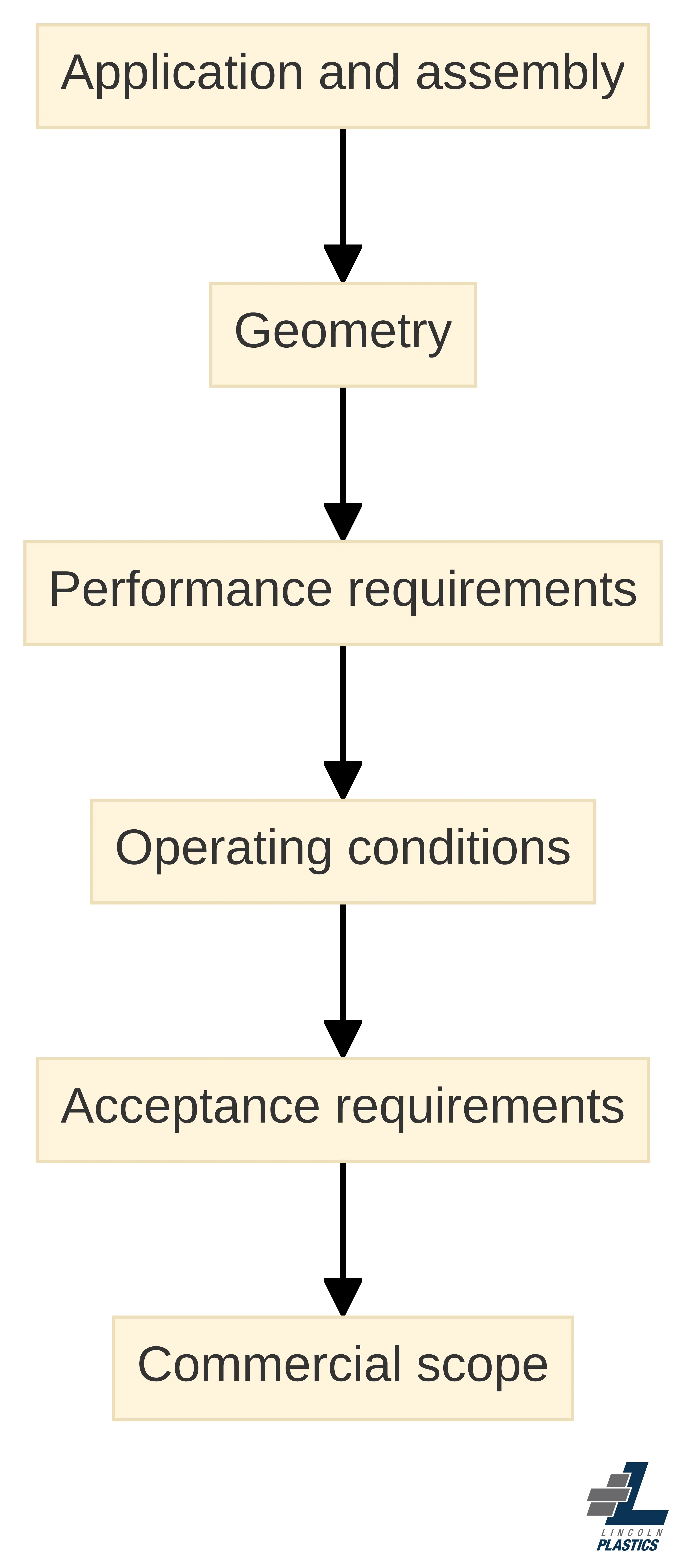
Treat Material and Geometry as Connected Questions
Material and geometry are connected questions because the material affects how the requested form behaves during extrusion, while the geometry defines what the finished component must achieve. PVC, polyethylene, and polypropylene have different properties that influence their behavior during extrusion. Strength, flexibility, and thermal resistance should be defined before you evaluate a material or extrusion.
Do not begin with a preferred resin name unless your engineering or resin-supplier process has already established that direction. Provide the application requirements and ask the extrusion supplier to discuss manufacturability, tolerances, tooling, and production considerations. Material selection should remain customer-specified or recommended by the resin supplier; Lincoln Plastics’ documented role is to provide extrusion expertise and guidance on the manufacturing implications.
Use the following material questions in your inquiry:
- Which strength requirement must the component meet?
- How much flexibility or rigidity does installation and service require?
- What thermal-resistance range applies to the equipment?
- What outdoor or UV-exposure requirement should the proposed material address?
- Does the component contact a fluid, lubricant, cleaner, soil, or another substance that your team has identified?
- Does the material direction affect color, flexibility, surface, or another requested characteristic?
- Does the proposed material direction change tooling or process considerations?
- Which material properties need to be confirmed by the resin supplier or through project testing?
These questions identify the information needed for a material discussion. They do not authorize a material choice or promise a performance result.
Geometry should be discussed with the extrusion process rather than isolated on a drawing. In pipe extrusion, die design influences the consistency of the circular shape and wall thickness and can affect uneven flow, melt fracture, and surface imperfections. Extrusion tolerances should be developed with the application, material, and manufacturing process in view.
For a round pipe or tube, identify the dimensions that control the interface and the dimensions that are descriptive but less critical. Tell the supplier whether the wall must be uniform, whether concentricity matters, whether the tube must slide over or into another part, and whether the ends require a defined cut condition. If a profile includes a non-round feature, show how that feature fits into the assembly.
A complete geometry discussion helps the supplier distinguish a nominal size from a functional requirement. It also gives your team a better basis for reviewing any proposed tolerance.
If your pipe or tube requires more than one material or color, describe the reason for that requirement and ask whether the proposed construction applies to your geometry.
Do not add co-extrusion simply because it appears in a supplier capability list. Use it only when the application record identifies a supported reason, such as a required multi-material or multi-color profile. The supplier still needs to confirm whether the arrangement is appropriate for the requested component.
Ask How Dimensions Will Be Controlled
Dimensional control begins with a requirement that explains what the dimension does. A wall-thickness number without an application reason may be difficult to evaluate; a wall-thickness requirement tied to fit, rigidity, fluid passage, or protection gives the supplier a defined review point.
In pipe extrusion, die design influences circular shape and wall-thickness consistency. Extrusion tolerances should account for the application, material, and manufacturing process. Ask how the proposed tooling and process will address the dimensions that matter to your assembly, then ask how those dimensions will be checked during production and at release.
The goal is not to demand a generic tolerance before the supplier reviews the design. The goal is to connect each tolerance to the function it protects and to obtain a process-specific response.
Ask the supplier questions such as:
- Which dimensions are likely to require the tightest control for the stated fit or function?
- How will die design relate to circular shape and wall-thickness consistency?
- Which dimensions should be measured during production?
- What measurement method and sampling approach will apply?
- How will material behavior and process conditions affect the requested tolerance?
- Which features require a drawing clarification before tooling or quotation?
- What information should be included in the acceptance criteria?
- How will a dimensional concern be communicated and resolved if production results differ from the requirement?
These questions help you evaluate the supplier’s reasoning. They do not establish a particular tolerance or guarantee a dimensional result.
Fit and function should appear together in the supplier discussion. Lincoln Plastics’ sourcing guidance identifies special checks for fit and function as part of evaluating extruded products. Pipe-extrusion evidence also connects die design with circular shape, wall-thickness consistency, flow, and surface outcomes.
Translate the check into an observable requirement. For example, identify the mating part, insertion or clearance condition, required movement, connection, or fluid path that the tube must support. Then ask which dimensions or characteristics will be checked against that requirement.
A supplier response that lists equipment or materials without connecting them to your critical features leaves the fit question open. Keep that boundary visible in your comparison record.
Outdoor exposure should be recorded as an application requirement rather than treated as an automatic result of using plastic tubing. State the expected exposure and the UV-resistance requirement your project team has defined, then ask how the proposed material and process will be evaluated for that requirement.
Define application requirements such as strength, flexibility, and thermal resistance before evaluating an extrusion. Apply the same disciplined approach to outdoor exposure: identify the condition, connect it to the component’s service, and request a project-specific response. Do not use a general irrigation application label as proof of UV resistance or service life.
Check Project-Specific Confirmation Separately
Separate what Lincoln Plastics says about its work from what your particular component still requires. Its stated offering includes custom plastic extrusion tubing for OEM applications that include irrigation, along with pipes, tubes, and flexible profiles. Its stated design advice can support an initial discussion, but it does not answer every question about a center-pivot part.
For this project, the first record is the supplier’s relevant product and application scope. The second record contains the component identity, geometry, material direction, exposure, dimensional controls, quantity, and commercial terms that require a response. An irrigation application can justify contacting Lincoln Plastics; it cannot confirm wall thickness, UV resistance, tolerance, price, or lead time for your part.
Build a supplier-evidence record with four sections:
- Credentials and quality evidence: Record the certification or credential identified by the supplier and ask how it applies to the requested product and production process. Lincoln Plastics is documented as certified to the ISO 9001 standard.
- Relevant experience: Record the supplier’s documented experience with the product form and application category, such as OEM irrigation tubing.
- Production capability: Record the answer about tooling, extrusion form, dimensions, materials, quantities, and process controls for your specific project.
- Communication: Record who answers technical questions, who owns quotation changes, and how open items will be tracked.
The certification statement supports a quality-management credential, not a conclusion that your part is compliant, approved, or suitable. The relevant application statement supports an initial conversation, not a completed qualification.
A useful supplier response should address your actual requirement record. Look for clear separation between confirmed facts, proposed options, assumptions, and questions that need your answer. A response that merely repeats a general tubing capability does not resolve project-specific dimensions or performance requirements.
Ask for the response in a form your engineering, purchasing, and quality teams can use. That may include a marked-up drawing, a list of open requirements, proposed material direction, tooling discussion, dimensional-control approach, quality documentation, and commercial assumptions. Do not treat a supplier’s willingness to discuss the project as confirmation that every item has been accepted.
Send the Defined Pipe-and-Tube Inquiry
Include direct questions that produce usable answers:
- Can you review this pipe or tube requirement for the stated OEM irrigation application?
- Which dimensions and interfaces should be treated as critical to fit or function?
- What information do you need to evaluate wall thickness, circular shape, and tolerance?
- Which material questions should be directed to the resin supplier, and which manufacturing questions can you review?
- How would the requested outdoor and UV-resistance requirement enter the material and process discussion?
- What tooling or process considerations should be addressed before quotation?
- Which inspection or quality records would accompany the proposed product?
- What quantity, packaging, and shipping assumptions would the quotation use?
- Which items remain unconfirmed after the initial review?
The wording keeps the inquiry focused on confirmation. It does not ask the supplier to approve a design without the information needed for that decision.
Before sending, use this short checklist:
- The application and component function are stated.
- The drawing, sample, or dimensional record is attached.
- Wall thickness, sizing, length, and critical interfaces are identified.
- Strength, flexibility, thermal resistance, and exposure requirements are listed.
- The UV-resistance requirement is described without assigning an unsupported material result.
- Material direction is labeled as customer-specified, resin-supplier-recommended, or open.
- Fit-and-function checks and acceptance questions are included.
- Quantity, destination, packaging, and quotation assumptions are included.
- Unconfirmed technical and commercial details are listed separately.
- The identity of the supplier being contacted is clear.
A complete inquiry improves the quality of the discussion because it gives the supplier a defined project to review. It does not guarantee a quotation, production acceptance, or technical outcome.
Keep the supplier’s response with the original inquiry. Mark each item as confirmed, proposed, open, or rejected, and record the person responsible for the next answer. Compare the response with the application record rather than with a general capability page.
If the supplier provides a certification statement, technical recommendation, material discussion, tooling response, inspection approach, or commercial assumption, place it in the corresponding section of your project record. This separation prevents a general product claim from being mistaken for confirmation of a specific requirement.
Make the Identity-and-Fit Decision
Resolve the search in order. First, do not treat Lincoln Plastics as the business named Fabricated Extrusion Company without separate identity confirmation. Second, if you are seeking a supplier for an agricultural or OEM pipe-and-tube component, Lincoln Plastics is a relevant candidate because it provides custom plastic extrusion tubing for OEM applications that include irrigation and tailored solutions that include pipes, tubes, and flexible profiles. Lincoln Plastics also offers advice on the design of plastic extrusion tubing and custom pipes.
That answer establishes relevance, not selection. Before treating Lincoln Plastics as selected for your equipment, confirm the component identity, application, sizing, wall thickness, material direction, exposure and UV-resistance requirement, dimensional controls, quality evidence, quantity, packaging, timing, and commercial terms.
If the goal is the separately named business, resolve that identity. If the goal is an agricultural or OEM pipe-and-tube source, send Lincoln Plastics the component details and use its response to decide whether the project should advance. A qualified engineering professional should decide individual suitability for your equipment and service conditions.
The immediate next step is to assemble the drawing or dimensional record, application conditions, performance requirements, quantity assumptions, and open questions into one inquiry. Ask for a response that separates confirmed capability from project-specific items requiring review. That gives your engineering, purchasing, and quality teams a shared basis for the next decision.


