

What pipe extrusion must accomplish
Extrusion melts plastic and forces it through a die to create the desired shape and size. The die establishes the starting geometry; the downstream stations stabilize that geometry and prepare the product for cutting or coiling. Custom extruded products are made to order from customer requirements, so the process begins with a defined product rather than with a generic pipe size.
The useful distinction for an RFQ is the product geometry you need. A pipe or tube request asks for a tubular cross-section with stated dimensions and wall thickness. A profile request may use a different cross-section and therefore a different drawing, die, and inspection focus. Describe the product by its intended geometry instead of relying on the broad word “extrusion.”
Pipe extrusion works as a linked control chain:
- Material preparation establishes what enters the process.
- Tooling forms the initial shape.
- Sizing and cooling stabilize the dimensions.
- Haul-off controls how the product moves through the line.
- Cutting or coiling determines how the finished length is supplied.
- Inspection checks the agreed requirements.
That sequence gives you a practical way to evaluate a supplier discussion. Ask what each stage controls, what information the supplier needs before quoting, and how the finished pipe will be checked against the specification.
The extrusion line from material to finished pipe
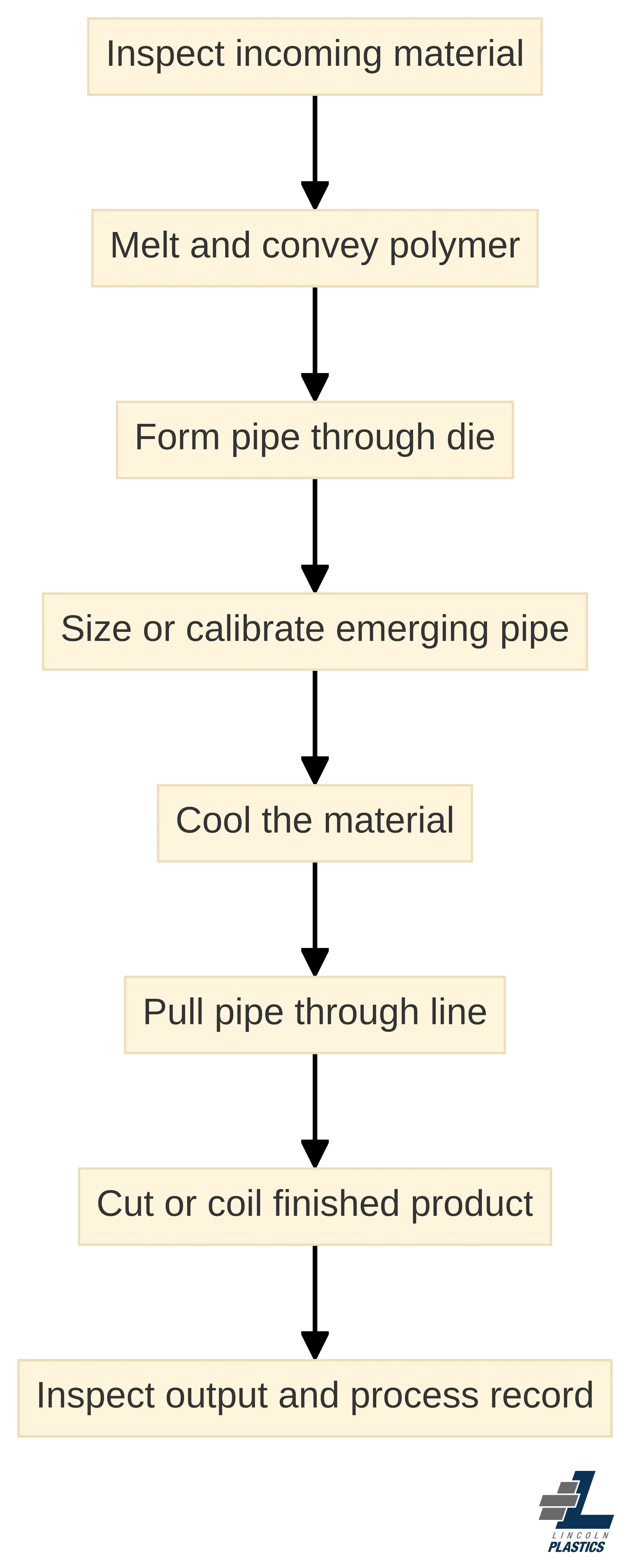
A typical pipe extrusion line includes tooling, sizing or calibration, cooling, haul-off, and cutting or coiling. Inspection takes place through the process and on the finished product rather than appearing as a substitute for the production stages.
-
Inspect the incoming material. Check the material specification and look for contaminants before production. Different plastics respond differently to processing conditions, so the material record belongs in the project file before the line is set up.
-
Melt and convey the polymer. The extrusion process melts the plastic and forces it through a die that creates the requested shape and size. Tooling is therefore tied to the drawing and to the dimensions that matter in service.
-
Form the pipe through the die. The die creates the initial tubular geometry. At this point, the shape is not yet the finished, inspected pipe; the next stations establish and stabilize its dimensions.
-
Size or calibrate the emerging pipe. Sizing conditions help establish the outside diameter, wall thickness, and roundness required by the specification. Stability at this station matters because dimensional changes can continue to appear downstream.
-
Cool the material. Cooling helps the extruded shape retain its dimensions. Cooling consistency is one of the process conditions associated with dimensional control.
-
Pull the pipe through the line. The haul-off or puller moves the product at a controlled rate. Its draw relative to line speed can affect outside diameter, wall thickness, and ovality.
-
Cut or coil the finished product. The line can cut the pipe to defined lengths or coil it when the product and handling requirements call for that form of supply.
-
Inspect the output and the process record. Dimensional measurement, surface inspection, and other agreed checks provide the evidence that the production run remains within the required product specification. The exact inspection plan belongs in the RFQ rather than being assumed from the word “pipe.”
Where pipe dimensions are established
Pipe dimensions are established across several linked stations, not at the die alone. Outside diameter, wall thickness, and ovality are affected by puller draw relative to line speed, sizing stability, cooling consistency, and tooling alignment. A drawing that lists dimensions without describing the application and material leaves the supplier with less information to judge how those dimensions should be produced.
Treat each dimensional requirement as part of a production relationship:
- Tooling and alignment establish the initial geometry and its position as the pipe enters sizing.
- Sizing conditions support the requested outside shape and dimensions.
- Cooling helps the material retain the geometry established upstream.
- Haul-off draw changes how the product moves and can affect the resulting dimensions.
- Inspection determines whether the measured output matches the agreed requirements.
Tolerance values should be developed with the application, material, and manufacturing process in view. Do not copy a tight number onto a drawing without identifying what function that number protects. Instead, separate critical dimensions from reference dimensions and explain the fit, interface, or operating requirement connected to each critical dimension.
A useful RFQ states the target dimensions, wall thickness, permitted variation, measurement locations, and the function affected by each requirement. If the dimensions are still preliminary, label them as such and ask the supplier to discuss manufacturability before treating them as final acceptance criteria. This keeps the process discussion tied to the product you need rather than to isolated numbers.
Why dimensional drift requires process diagnosis
Dimensional drift is a process-diagnosis problem because several line conditions can affect the same pipe measurement. Puller draw relative to line speed, sizing vacuum or air-support stability, cooling consistency, and tooling alignment all have a relationship to outside diameter, wall thickness, and ovality. Material should not be treated as the automatic explanation when a dimension moves.
If dimensions drift, use the cited troubleshooting order:
- Check sizing conditions, including vacuum or pressure and alignment.
- Check cooling stability.
- Check puller speed or draw.
- Review the material only after those process conditions have been considered.
This order gives the supplier a concrete starting point for a deviation discussion. Ask which measurement changed, where it changed along the run, and which process record covers that interval. During extrusion, melt temperature, pressure, and flow rate can also be monitored; automated data gathering can support real-time adjustments and early defect identification.
The practical RFQ implication is simple: request the dimensional checks and process information that relate to your critical requirements. A supplier conversation becomes more useful when it covers both the measured defect and the line conditions that could have produced it.
Turn the application into a pipe specification
A pipe specification should describe the job the product must perform before it fixes every manufacturing detail. Custom extruded products are made from customer requirements, while dimensional tolerances need to account for the application, material, and manufacturing process.
Build the working specification from these fields:
- Material direction: State the resin, grade, color, additive package, or customer-specified material when those decisions are already made. If the material is undecided, identify the service conditions and ask the resin supplier or qualified engineering team to recommend candidate compositions. Do not treat a material name alone as proof of suitability.
- Geometry: State the outside diameter, wall thickness, cross-section, length, and any interfaces that must fit another component. Attach a drawing when the shape cannot be described reliably in text.
- Tolerances: Identify the dimensions that control fit or function, the permitted variation, and how those dimensions should be measured. Develop those limits with the application, material, and process in view.
- Operating conditions: Describe indoor or outdoor use, expected exposure, temperature range, contact with other materials, handling loads, and any other condition that could change the requirement. Use the actual service description rather than a broad label such as “industrial.”
- Exposure requirements: State whether the pipe will face prolonged sunlight or weather and what evidence you expect for that condition. Outdoor suitability is a defined material and testing question, not a conclusion from appearance alone.
- Volume and supply form: Include prototype quantity, expected production volume, order frequency, required lengths, coils or cut pieces, packaging, and target timing. These details help the supplier discuss the production request in commercial terms.
End the specification with open questions. A partially defined requirement is useful when it clearly separates confirmed values from items that need technical discussion.
Treat outdoor exposure as a defined requirement
Outdoor exposure is a material-composition requirement tied to the conditions the pipe will face. Thermoplastic piping intended for prolonged outdoor exposure requires weather resistance suited to those conditions, and selected additives can improve weatherability. The correct composition cannot be chosen from the word “outdoor” alone.
Describe the exposure in the RFQ:
- State whether the pipe will remain outdoors or spend only limited time outdoors before installation.
- Describe the expected sunlight, weather, location, and exposure duration.
- Identify the performance change that matters, such as retaining dimensions, appearance, flexibility, or another specified property.
- State whether the project requires a particular test method, comparison, or acceptance limit.
UV and weathering evaluations can use fluorescent-UV or xenon-arc exposure methods. Referenced methods include ASTM G154, ASTM G155, ASTM D2565, ASTM D4329, and ISO 4892-2 or ISO 4892-3. Those method names are starting points for a testing discussion; they do not replace a defined exposure condition or acceptance requirement.
Ask the supplier which material composition and evaluation approach match the conditions in your application. Keep the question specific enough to distinguish a short-term handling requirement from prolonged outdoor service. That distinction gives the supplier a clearer basis for discussing material direction, testing, and the evidence that should accompany the quotation.
What quality evidence should cover
Quality evidence should connect the incoming material, production conditions, measured dimensions, and finished pipe to the product specification. During extrusion, quality controls help verify that production remains compliant with the required specifications; they are not a universal checklist that applies identically to every pipe.
A project-specific control plan may address:
- Incoming material: specification conformity and contamination checks before production.
- Process conditions: melt temperature, pressure, and flow rate, with process data gathered when that supports adjustments or defect identification.
- Dimensions: measurements for outside diameter, wall thickness, ovality, length, and other dimensions identified as critical in the drawing.
- Surface condition: visual inspection for imperfections or irregularities relevant to the finished product.
- Material consistency: density and homogeneity checks when the product requirements call for them.
- Mechanical properties: resistance, flexibility, hardness, or another agreed property when the intended use requires that evidence.
- Thermal control: temperature management that protects the material during processing and supports the required product quality.
Ask the supplier to identify the inspection frequency, measurement method, sample location, record format, and response to a nonconforming result. Set those details against your own acceptance criteria rather than assuming that a named test automatically defines acceptance.
We are certified to the ISO 9001 standard. That business fact belongs in supplier qualification, while the RFQ still needs to identify the product-specific measurements and records you require.
Questions for diagnosing pipe dimensional drift
Dimensional stability is a useful way to organize a pipe-extrusion process review. Outside diameter, wall thickness, and ovality can be affected by puller draw relative to line speed, sizing stability, cooling consistency, and tooling alignment. Focusing on those linked controls gives an OEM or agricultural buyer a practical way to discuss process records and inspection evidence.
1. Define the observed drift
Start with the measured symptom rather than assuming its cause.
- Which dimension changed: outside diameter, wall thickness, or ovality?
- What measurement method identified the change?
- What required product specification or agreed tolerance applies to that dimension?
- Is the variation repeatable, or does it appear at particular points in the run?
Tolerance values should be developed with the application, material, and manufacturing process in view. They should not be treated as independent numbers that apply to every pipe project.
2. Follow the dimensional checks in order
When dimensions drift, review the process conditions in a defined sequence:
- Check sizing conditions, including vacuum or pressure stability and alignment.
- Check cooling consistency.
- Check puller speed or draw relative to line speed.
- Review the material only after those process conditions have been examined.
This sequence helps keep a dimensional investigation focused. It does not establish a universal acceptance limit or replace the requirements for a particular pipe application.
3. Ask how tooling and sizing establish geometry
Tooling alignment and sizing conditions influence the geometry that the line is trying to hold. Questions for a process review include:
- How was the tooling aligned to the requested pipe geometry?
- Which sizing or calibration conditions were used?
- How were outside diameter, wall thickness, and ovality measured during production?
- Which condition would be checked first if one of those dimensions began to drift?
The answers should relate the measurement to the applicable specification, not to a generic tolerance assumed for every material or size.
4. Request the process information that can explain variation
During extrusion, melt temperature, pressure, and flow rate can be monitored. Automated data gathering can support real-time adjustments and early defect identification. A focused supplier discussion can therefore ask:
- Which of those process parameters were recorded?
- What changes in temperature, pressure, or flow accompanied the dimensional change?
- Which sizing, cooling, and haul-off conditions were recorded at the same time?
- What tooling or alignment checks were performed?
Raw materials should also be inspected before production for specification conformity and contaminants, because plastics respond differently to processing conditions. That check is part of the investigation, but the available troubleshooting sequence places sizing, cooling, and puller conditions before assuming that the material is the cause.
5. Separate outdoor exposure from dimensional diagnosis
For prolonged outdoor exposure, the pipe material composition needs weather resistance suited to the specific conditions. Selected additives can improve weatherability, but the required composition depends on the exposure being considered. An agricultural buyer can ask:
- What outdoor conditions and exposure period define the weather-resistance requirement?
- Which fluorescent-UV or xenon-arc evaluation method matches that defined exposure?
- Which results or records will be associated with the material and the finished pipe?
Referenced evaluation methods include ASTM G154, ASTM G155, ASTM D2565, ASTM D4329, and ISO 4892-2 or ISO 4892-3. These references identify possible evaluation methods; they do not create a universal test requirement for every pipe.
6. Match inspection evidence to the requirement
Quality controls during extrusion help verify that production remains compliant with the required product specifications. Depending on the project, controls may include dimensional measurement, surface inspection, density and homogeneity checks, mechanical-property testing, and thermal control.
Questions that keep the inspection discussion specific include:
- Which dimensional and surface checks apply to the agreed pipe specification?
- Which material, mechanical, or thermal checks are relevant to the intended use?
- What measurement method and record will demonstrate conformity?
- Which checks would help distinguish a sizing, cooling, puller, tooling, or material issue if dimensions drift?
The appropriate checks depend on the application, material, and manufacturing process. A buyer should ask for the checks that address the defined requirement rather than assume that every possible test is necessary.
7. Keep the RFQ focused on process evidence
For an RFQ, ask the extrusion supplier to identify the dimensional measurements, process records, and inspection checks that would support a review of pipe stability. Include the observed dimension, the applicable specification, the relevant application or exposure conditions, and any known process history. If a requirement is still open, label it for technical review instead of assigning an unsupported tolerance or test method.
This approach makes the RFQ a request for specific evidence about dimensional control. It preserves room for the customer and resin supplier to resolve material questions while asking the extrusion supplier to address manufacturability, sizing, cooling, haul-off, tooling alignment, and inspection records.
Use pipe acceptance questions to frame an RFQ
Frame the discussion around three pipe acceptance questions: Will the required outside diameter, wall thickness, and ovality remain stable? Does the material's weather resistance suit the intended exposure? Which quality controls will verify compliance with the required specification? If dimensions drift, check sizing conditions, cooling stability, and puller speed or draw before assuming the material is the cause. Develop tolerances with the application, material, and manufacturing process in view rather than treating tolerance numbers independently of those factors. These questions give an OEM or agricultural buyer a focused basis for discussing manufacturability and inspection evidence with a supplier.
We provide custom plastic extrusion tubing for OEMs, including irrigation and cord-cover applications. We also provide tailored OEM solutions that include pipes, tubes, and flexible profiles.
What should a buyer confirm before requesting a pipe extrusion quote?
What is the pipe extrusion process?
Pipe extrusion involves melting polymer and forcing it through a die to create a pipe or tube. The process includes stages such as material preparation, tooling, sizing, cooling, haul-off, and cutting or coiling.
What factors affect the dimensions of extruded pipes?
The dimensions of extruded pipes, including outside diameter and wall thickness, are influenced by factors such as puller draw relative to line speed, sizing stability, cooling consistency, and tooling alignment.
How can I ensure quality control during the extrusion process?
Quality control during extrusion can include monitoring incoming material specifications, process conditions like melt temperature and pressure, and conducting dimensional and surface inspections on the finished product.
What should I include in a specification for custom extruded pipes?
A specification should detail material direction, geometry, tolerances, operating conditions, exposure requirements, and supply form, along with any open questions for the supplier.
What are the requirements for outdoor exposure of thermoplastic piping?
Thermoplastic piping intended for outdoor use must have weather resistance suited to specific conditions, and selected additives can enhance weatherability. It's important to define the expected exposure in the RFQ.
What questions should I ask a supplier when discussing extrusion projects?
Key questions include inquiries about material specifications, critical dimensions, process controls, outdoor exposure requirements, and the inspection plan for quality assurance.
How does dimensional drift occur in extruded pipes, and how can it be diagnosed?
Dimensional drift can occur due to variations in sizing conditions, cooling stability, and puller speed. Diagnosing it involves checking these factors in a specific order before attributing issues to the material.


