

Audit the evidence behind supplier answers
Before comparing custom profile extrusion suppliers, audit the accountability behind each consequential answer. Trace who owns the decision or production step, what can be checked, and what condition would keep the response unresolved. This shifts the review from catalog breadth or unit price alone to whether a supplier's answer is attributable, applicable to the profile, and supported by an identifiable check.
Use the RFQ as the audit's input rather than as its conclusion. Include drawings, tolerances, target polymer, annual volume, and applicable certification requirements so each supplier reviews the same project information.
Keep a supplier-accountability audit that records:
- The party responsible for the material decision, profile requirement, tolerance, or quality requirement. Material selection remains customer-specified or recommended by the resin supplier; the extrusion supplier can be assessed on manufacturability guidance, tolerances, co-extrusion options, and production considerations.
- Whether the supplier owns its tooling and runs its own extrusion lines or resells another shop's parts.
- Which production step or answer the supplier controls and which depends on another party.
- The drawing, certificate, measurement, sample, or stated commercial condition that supports each consequential answer.
- How custom-profile tooling is priced and how its cost is spread across projected order quantities.
- Which application-specific certifications require checking, such as ISO 9001, FDA or USP Class VI, UL 94, REACH, or RoHS where relevant.
When a supplier proposes tight tolerances, identify the profile areas that are critical to fit and function and relate the requirement to the intended use. Extremely tight tolerances can raise tooling costs, extend setup times, and increase scrap rates, so the audit should show why each critical tolerance is needed.
Mark each audit item as confirmed, conditional, a supplier question, a customer decision, or not included. Clarify an answer when the responsible party or supporting check is unclear; hold it when the relevant condition cannot be stated. Advance the discussion only when the requirement, responsibility, supporting evidence, and commercial condition are visible. This record gives purchasing, engineering, and quality teams a common basis for separating a checkable supplier response from an unresolved capability statement.
Assign application decisions before comparing suppliers
Begin with an application record that assigns each condition to a requirement row before comparing supplier responses. A catalog may show shapes or material names, but the map must show the operating condition, acceptance criterion, and party responsible for resolving any open question.
Populate the application rows before supplier discussions:
- The equipment, assembly, or system where the profile will be used.
- The profile function, such as sealing, guiding, protecting, spacing, insulating, covering, supporting, or managing a cable or hose.
- Exposure to operating temperature, sunlight or other UV conditions, moisture, chemicals, abrasion, impact, and repeated flexing where those conditions apply.
- Whether the profile must remain rigid or flex during installation or service.
- Contact surfaces, mating parts, load direction, insertion method, and removal requirements.
- Required color, opacity, surface appearance, cut length, packaging, and identification.
- Annual volume, expected order pattern, launch timing, and any transition from trial quantities to production quantities.
Material selection can address operating temperature, UV resistance, coloration or opacity, and flame-resistance requirements, while rigid and flexible behavior remains a separate design consideration. cite Treat each condition as a question for the material direction and the manufacturing review; do not assume that a familiar resin name settles the application.
The application record also helps you distinguish a profile requirement from a general purchasing preference. For example, a cable protection profile may need controlled flexibility and abrasion resistance, while an industrial machinery guide may place more weight on rigidity, impact resistance, fit, and dimensional repeatability. Those are different requirement sets even if both parts are described broadly as plastic profiles. The supplier response should address the actual use, not merely match a product category.
Finish the application rows by marking the conditions that would cause rejection, the evidence needed to check them, and the questions that remain open. A part that looks acceptable but does not fit the mating component, hold its required shape, or tolerate the stated environment has not met the purchasing requirement.
Keep material authority separate from manufacturing guidance
Keep material authority separate from extrusion guidance. In the map, record the customer- or resin-supplier-specified material direction as an input, then record the extrusion supplier's response on manufacturability, profile behavior, and production considerations. Do not treat a supplier's general resin discussion as a decision on behalf of the specification owner.
PVC, HDPE, ABS, and PP can appear as candidate material directions in a project brief, but the name alone is not a complete specification. Record the grade or formulation when it is known, along with the properties that matter in service. If the grade remains open, identify who will recommend it and what application information that recommendation must address.
Use these questions to keep the discussion specific:
- What operating-temperature range must the profile accommodate?
- Will UV exposure, outdoor use, moisture, chemicals, or abrasion affect the requirement?
- Does the part need rigidity, controlled flexibility, or a combination such as a rigid body with a flexible feature?
- Does the design require a particular color, opacity, flame-resistance direction, or insulating property?
- Are there restrictions on additives, recycled content, regulatory status, or customer-approved materials?
- Which material characteristics must be demonstrated through a certificate, test report, sample, or production inspection?
Material selection can be directed toward operating temperature, UV resistance, coloration or opacity, and flame resistance, but those requirements still need to be connected to the intended use. cite Rigid plastics suit applications where durability and impact resistance matter, while flexible plastics can be engineered for rubber-like properties; that distinction helps frame the design question but does not approve a particular grade for your part. cite
Flexible PVC is widely used in profile extrusions for abrasion resistance and insulation. cite Use that as context for a material discussion, not as a universal recommendation. Your record should still state the actual exposure, performance requirement, and acceptance method.
Keep the roles distinct in the map. Your organization or resin supplier specifies or recommends the material direction; the extrusion supplier provides manufacturing guidance, identifies design implications, and explains how the selected direction will be handled in production. If the material decision is still open, mark that row for clarification rather than treating an unconfirmed recommendation as supplier evidence.
Use critical features to test tolerance reasoning
Use the geometry record to isolate critical-feature rows instead of treating every dimension as an equal scoring item. Extrusion tolerances affect fit, function, and overall part performance. cite For each critical feature, record the function it controls, the requested tolerance, the measurement that would demonstrate it, and the supplier's explanation of the manufacturing or cost consequence. This makes an unresolved tolerance question visible before it is treated as a comparable offer.
Give the supplier a usable geometry record that includes:
- A current cross-section drawing with units, datums, wall dimensions, radii, openings, lips, slots, holes, and other features.
- The dimensions that control mating, sealing, insertion, retention, clearance, or movement.
- Cut lengths, allowable length variation, end conditions, and any required secondary operations.
- Straightness, twist, bow, surface, color, and appearance requirements where they affect assembly or acceptance.
- Flexible features, hard-to-soft transitions, co-extruded areas, and locations where a change in material behavior is intentional.
- A clear distinction between critical dimensions and reference dimensions.
Use the intended use to decide which profile areas become the map's critical-feature rows. Identifying critical areas and setting their tolerances according to use is a supported design practice. cite For each row, ask whether the proposed tolerance is necessary, what measurement will demonstrate it, and what consequence follows if it is missed.
Length tolerances can vary with material properties, profile design, and cutting methods. cite Therefore, do not treat cut length as an isolated purchasing number. State how the length is used, how it will be measured, and whether the part is supplied continuously, in fixed lengths, or in another format required by your assembly.
Overly stringent tolerances can raise tooling costs, extend setup times, and increase scrap rates. cite Extremely tight tolerances can also increase the cost of a custom extrusion. cite The purchasing decision is not to loosen every tolerance; it is to reserve tight control for the features that affect fit and function, then ask the supplier to identify the manufacturing and commercial consequences.
Close each critical-feature row with the supplier's production explanation: which feature needs special control, how tooling will form it, how cooling and sizing affect the profile, how measurement will occur, and which dimensions require agreement before a quote becomes meaningful. If those links remain unclear, mark the row for clarification rather than treating the first price as a comparable offer.
Trace production answers to accountable parties
Trace each production answer to an accountable party before treating it as supplier evidence. Ask whether the supplier owns its tooling and runs its own extrusion lines or resells another shop's parts. cite Record who must address a drawing change, a difficult tolerance, or a production issue, rather than treating a general production statement as proof of control.
Use one responsibility line for each part of the project and ask the supplier to identify its role:
- Design review and manufacturability feedback.
- Tooling design, ownership, maintenance, and revision control.
- Material receipt, identification, and handling.
- Extrusion setup, cooling, sizing, and process adjustment.
- In-process measurements and reaction to an out-of-limit result.
- Cutting, finishing, packing, labeling, and shipment preparation.
- Nonconformance review, corrective action, and engineering-change communication.
Different suppliers may use different operating models; the comparison question is whether the boundary is explicit. Record what the quoted service includes, which activities another party performs, the responsible location or organization for each outsourced step, the records that follow the part, and the point at which your approval is required. A response is incomplete when that responsibility boundary or approval point remains unclear.
Tooling deserves a separate record. Ask who owns the tool, who pays for changes, how revisions are controlled, how tooling cost is calculated, and how that cost is allocated across projected order quantities. The recommendation to ask how custom-profile tooling is priced and spread across projected quantities is directly relevant to per-part economics. cite Keep tooling ownership and tooling payment separate; they are different commercial questions. Also separate control of the tool from the supplier's responsibility for maintaining or revising it. Record the answer for each question, the change-approval point, and the quantity basis used in any allocation. If a response leaves ownership, revision responsibility, or cost allocation open, retain those items as unresolved rather than treating operation of an extrusion line as an answer to the tooling or commercial question.
Read quality evidence as an application gate
Treat quality as an evidence gate tied to the application, drawing, and acceptance method rather than as a general statement about supplier quality. Quality control is important for preventing production issues in polymer extrusion. cite For each quality requirement, record how the supplier will control the relevant characteristic and what document or check will show the result.
For each quality requirement, add these evidence-map fields:
- Critical dimensions, tolerances, visual requirements, and functional checks.
- The measurement method, sampling approach, inspection frequency, and acceptance rule for each critical characteristic.
- Material identification and any required certificate or lot traceability.
- First-article, pilot, or production-approval requirements established by your organization.
- Handling of nonconforming parts, deviations, engineering changes, and corrective actions.
- Required records, retention period, reporting format, and contact for quality questions.
For each certification or compliance claim, record the application requirement it is meant to address, the document that supports it, and the approval point at which it must be checked. Certification claims should be checked against the specific application. Examples include ISO 9001, FDA or USP Class VI for medical-grade extrusion, UL 94 for flammability, and REACH or RoHS where relevant to the market. cite Those examples do not establish that your profile needs any particular certification; they show why the requirement must be tied to the product, market, and customer specification.
In the comparison record, distinguish a quality-system certification, a material or product qualification, and an inspection result for the specific order. Note which requirement is covered by a document and which depends on an agreed production check. A clear record lets you compare quality evidence without converting a general certification into an unsupported performance assurance.
End each quality row with an approval boundary. Mark any missing boundary for clarification so purchasing, engineering, and quality teams use the same decision record.
Turn supplier answers into a comparison record
Use the RFQ as the intake document and the comparison record as the decision artifact. Its purpose is not merely to collect quotes; it should give each supplier the same rows for requirement owner, response, evidence, and unresolved condition. Include drawings, tolerances, target polymer, annual volume, and applicable certification requirements in the RFQ. cite Add the commercial and production questions that determine whether the responses can be compared on equal terms.
For each RFQ block, capture four fields:
- Requirement owner. Identify whether the input comes from your organization, a resin supplier, customer quality requirements, or another agreed party.
- Supplier response. Record the supplier's production role, proposed handling, exclusions, and questions.
- Evidence or condition. Record the drawing, certificate, measurement method, sample or approval requirement, tooling assumption, quantity basis, or other specified support.
- Decision status. Mark the row as confirmed, conditional, supplier question, customer decision, or not included.
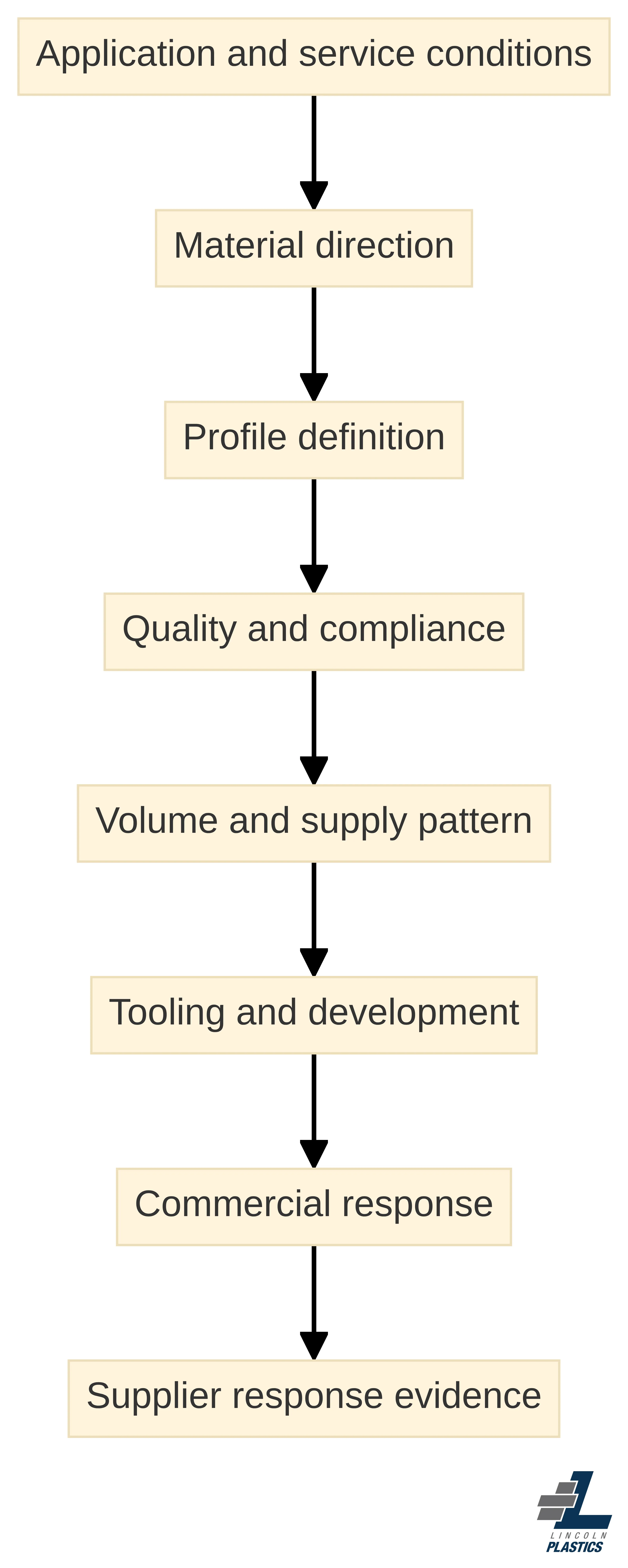
Apply those fields across application and service conditions; material direction; profile definition and tolerances; quality and compliance; volume and supply pattern; tooling and development; and commercial response. Preserve the details that affect comparison, including packaging, delivery location, quote validity, payment terms, lead-time assumptions, and minimum-run conditions.
Use the decision-status field to make uncertainty visible. If the material grade, annual volume, tolerance, or certification requirement is not final, label it as provisional and ask the supplier to state how that uncertainty affects the response. A provisional input should not be silently converted into a firm quote assumption.
Use the response matrix to compare answers field by field, not to assume that every supplier uses the same process. The status shows whether a row is confirmed, conditional, a supplier question, a customer decision, or not included; it does not establish that every item carries the same commercial weight.
The completed comparison record should show whether a supplier addressed the part you intend to buy and who owns each unresolved item. If the response covers only resin, shape, and price while leaving application, tolerance, quality, tooling, and supply conditions open, request clarification before ranking the offer.
Before issuing the RFQ, make the response format explicit. Ask each supplier to return the same drawing revision, identify assumptions, separate included work from exclusions, and identify the point at which a customer decision is required. Keep an open-issues register beside the response matrix so a missing answer is not mistaken for an unfavorable answer. For each unresolved row, record the question, responsible party, requested evidence, and stage at which clarification is needed. This record supports comparison without assigning an unsupported score to a supplier and gives engineering, purchasing, and quality teams a shared basis for reviewing changes when application or quantity assumptions change.
Use advance, clarify, and hold decisions
Use three decision states after the supplier response is mapped: advance when the requirement, accountable party, supporting evidence, and commercial condition are explicit; clarify when one is conditional or unanswered; hold when an application, acceptance, or scope requirement remains unresolved. These states do not rank suppliers or predict outcomes. They show what the next information request must address.
Keep technical and commercial rows separate in the map:
- Technical record: application, material direction, geometry, tolerances, quality evidence, production role, samples, and approval conditions.
- Commercial record: tooling price and ownership, unit price by quantity, minimum run, setup charges, lead-time assumptions, packaging, freight basis, payment terms, and quote validity.
Ask how custom-profile tooling is priced and how its cost is spread across projected order quantities. cite That question connects the development charge to the purchasing forecast without assuming a particular amortization method.
Ask suppliers to state the conditions behind any lead time, minimum run, or unit price. A lead time without a stated quantity, approval stage, material status, or tooling assumption is not a complete planning input. A minimum run without the quantity basis and order pattern is not a complete inventory decision. Treat each as a field requiring a defined condition, not as a standalone promise.
Tolerances also belong in the commercial conversation. Extremely tight tolerances can increase the cost of a custom extrusion, and overly stringent tolerances can raise tooling costs, extend setup times, and increase scrap rates. cite cite The appropriate response is to identify the dimensions that control fit and function, then record the cost and process effect of those requirements in the relevant row rather than accepting a blanket tolerance or removing a necessary one. Use the resulting status to determine whether the supplier discussion can advance or needs clarification. Keep a written distinction between an unanswered commercial condition and a negative supplier result. If a price excludes tooling, freight, or a required inspection, record the exclusion rather than estimating it. If a supplier states a lead time or minimum run without the assumptions that support it, return that row for clarification. The comparison can then show which differences arise from confirmed scope and which remain dependent on customer or supplier input. Treat the status as a record of the next information need, not as a conclusion about supplier quality or market standing.
Compare total sourcing exposure, not quoted unit price
Total sourcing exposure should be compared after the technical requirements are aligned. Unit price alone does not describe the purchasing cost of an extrusion program; the comparison should account for freight, tariffs, inventory, and communication overhead when evaluating domestic and overseas options. cite
Build the commercial comparison around the same quantity and supply assumptions. Include:
- Tooling and tooling changes over the expected program life.
- Unit price at the quantities your organization can actually order.
- Minimum-run requirements and the inventory created by those requirements.
- Freight mode, shipment frequency, packaging, duties, tariffs, and destination charges where applicable.
- Inventory carrying exposure created by longer or less flexible replenishment cycles.
- Sampling, inspection, rework, scrap, and change-management costs identified during review.
- Communication and coordination work required across organizations, locations, and time zones.
- The cost consequence of an unresolved tolerance, material, quality, or approval question.
Do not create false precision. If a supplier has not provided a freight assumption, tooling allocation, lead-time condition, or minimum-run basis, mark the comparison as incomplete and request that input. A lower provisional unit price should not outrank a technically complete response simply because the unresolved costs are outside the quoted line item.
Use sensitivity checks for the variables most likely to change the purchasing decision. Test different annual volumes, order quantities, tooling allocations, shipment patterns, and material-cost assumptions if those values remain open. Record which assumptions belong to your organization and which must come from the supplier.
The decision record should show both the calculated comparison and the boundaries around it. That gives purchasing a way to explain why a quote was selected, deferred, or returned for clarification without presenting an unconfirmed total as a committed cost.
Apply the screen to Lincoln Plastics without assuming missing terms
Use the same requirement record with Lincoln Plastics that you use with other suppliers. Provide the application conditions, material direction, drawing, critical tolerances, annual volume, certification requirements, quality expectations, tooling questions, delivery assumptions, and minimum-run questions. A complete RFQ should include drawings, tolerances, target polymer, annual volume, and applicable certification requirements.
Ask Lincoln Plastics to respond specifically to the open items:
- Which profile features require design or manufacturability discussion?
- Which material information should come from your team or resin supplier?
- How would the stated tolerances, cut lengths, and critical dimensions be reviewed?
- What tooling ownership, pricing, revision, and quantity-allocation terms would apply to the project?
- What production role, inspection approach, and quality records would be included?
- What lead-time assumptions, minimum-run conditions, order quantities, and shipping terms would shape the quote?
This screen lets you consider Lincoln Plastics on documented project fit without assuming pricing, lead time, minimum runs, certifications, geographic coverage, or other terms that have not been established for your requirement. Keep any unresolved field visible until the project discussion or written response supplies the needed condition.
Decide whether to request a project discussion
A supplier is ready for the next stage when your application record, material direction, geometry, tolerance strategy, quality requirements, production questions, tooling basis, and commercial assumptions can be reviewed together. Before you contact a supplier, separate confirmed requirements from open decisions and identify the evidence you need in the response. A complete RFQ gives the discussion a defined starting point rather than asking for a price against an incomplete part description. cite
For Lincoln Plastics, prepare the drawing, application conditions, target polymer or resin-supplier direction, annual volume, critical tolerances, quality requirements, and questions about tooling, lead time, minimum runs, and sourcing terms. We offer custom profile extrusion services tailored to OEM needs, including tailored solutions for pipes, tubes, and flexible profiles. cite cite
A qualified engineering or procurement professional should decide individual suitability, application approval, and commercial authorization for your organization. Contact Lincoln Plastics to discuss your custom profile extrusion requirement.


