
Decide whether the component fits continuous extrusion
Custom extrusion fits a component when its cross-section repeats along the length and the product can be made continuously before being cut or coiled. Use it for pipe, tube, channels, trims, rails, seals, and other repeatable profiles; use another process or secondary operations when the part depends on isolated three-dimensional features.
A constant cross-section gives the process its basic boundary. Extrusion is suited to continuous profiles, tubing, seals, channels, trims, pipes, rails, and weatherstripping, while injection molding is suited to individual three-dimensional parts. Extrusion cannot normally form isolated bosses, pockets, countersunk holes, or changing cross-sections directly.
Check your component against four questions:
- Does the shape repeat from one end to the other?
- Can the required length be cut from a continuous run?
- Are the features part of the full-length cross-section?
- Can holes, slots, bends, or end features be handled after extrusion?
A yes to the first two questions supports an extrusion review. A local feature does not automatically disqualify the part, but it belongs in the secondary-operation plan.
Long, repeatable profiles and continuous high-volume production are natural applications for extrusion. Record the component's required length, repeatable cross-section, and any local features before you build the RFQ. If the geometry changes along the length, identify that change as a separate manufacturing requirement rather than treating the entire part as a simple profile.
Define the application and service conditions first
The application record should state what the component must do, where it operates, and what conditions it will encounter. Material selection depends on stiffness, flexibility, temperature, chemical exposure, weather resistance, appearance, and co-extrusion requirements. Write those conditions before treating the selected resin as final. Plastic extrusion can be more favorable than aluminum when it reduces the number of manufacturing or fabrication steps. Compare extrusion, cutting, drilling, punching, and assembly requirements with the current component process before treating material substitution as a sourcing advantage for the component.
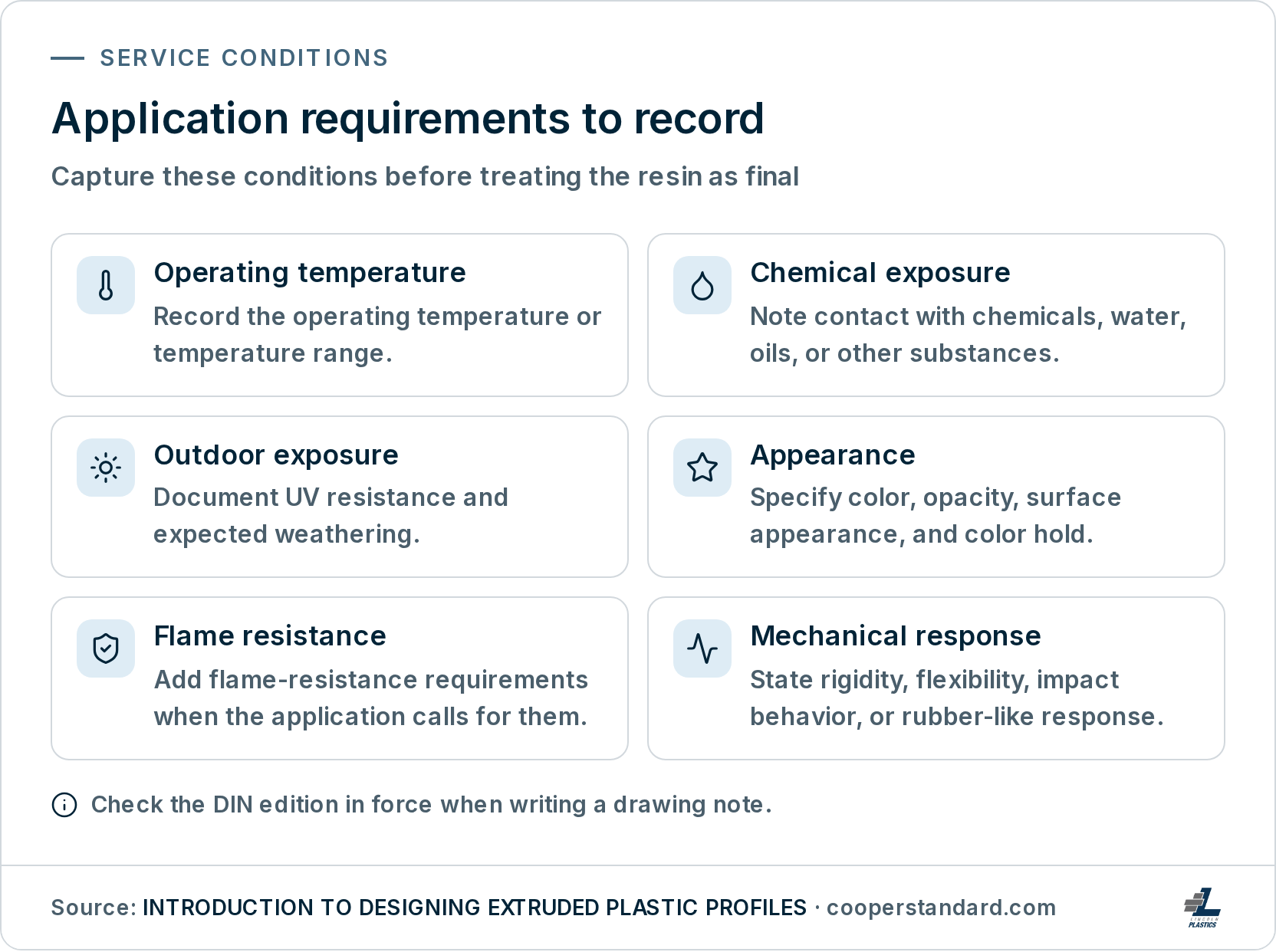
Specify the service conditions in a short checklist:
- Operating temperature or temperature range.
- Contact with chemicals, water, oils, or other substances.
- Outdoor exposure, UV resistance, and expected weathering.
- Color, opacity, surface appearance, and color-hold expectations.
- Flame-resistance requirements when the application calls for them.
- Required rigidity, flexibility, impact behavior, or rubber-like response.
- Any need for two materials or distinct layers in one continuous part.
For outdoor service, treat UV stabilization, pigment choice, impact-modifier system, and color-hold expectations as requirements. Do not leave them as informal preferences in the drawing or RFQ.
The drawing should identify the tolerance standard or quality specification that governs the part. If no application standard sets the tolerances, DIN 16941:2012-11 provides three tolerance series for an extruded profile's cross-section and longitudinal direction; it does not apply when another standard or quality specification governs. A DIN revision project started in July 2026 and will add acceptance criteria, so check the edition in force when you write a drawing note.

Gate 3: Separate die geometry from added features
The cross-section should show every full-length wall, channel, rib, lip, groove, and hollow section that must be formed through the die. Plastic extrusion can produce open U, J, or L channels and enclosed profiles with up to four internal lumens. Hollow profiles create challenges because their inner walls have no physical support after leaving the die, so keep internal geometry as simple as the application allows.
Wall thickness and cross-section consistency deserve a separate review. Extrusion design considerations include material flow, die swell, cooling, dimensional stability, and cut length. A simple cross-section and one with large wall-section differences do not present the same review questions.
Mark large wall-section differences, long unsupported features, and interacting dimensions on the drawing. Those features warrant supplier review before tooling, with the affected dimensions identified in the drawing. Note whether the concern belongs to the cross-section, the material, the tooling, the cooling process, or the measurement method. Keep this classification with the RFQ so the supplier can address each issue as a defined technical question.
Separate die-formed geometry from features that occur after extrusion. Full-length ribs, lips, channels, grooves, hollow sections, and edge details can be formed through the die. Cross holes, slots, end notches, angled cuts, local pockets, bends, and dimensions that change along the length normally require secondary operations such as punching, drilling, routing, sawing, or fabrication.
List each secondary feature with its location, quantity, orientation, and finished dimension. That record lets you request the correct combination of extrusion and downstream work.
One industry comparison reports extrusion tooling costs 80-90% lower than tooling for processes such as injection molding or die casting. That figure describes the comparison in that source, not a guaranteed cost for your component. Use the comparison only as a reason to examine continuous extrusion; request project-specific tooling and finishing costs for the actual geometry.
Gate 4: Confirm the specified material arrangement
The specified resin should follow the component's performance requirements. Identify the plastic type required for the project, such as PVC, polyethylene, or polypropylene. A material choice should account for the operating conditions recorded in the application brief.
Listed custom-extrusion materials include PVC, CPVC, ABS, PP, PE, HDPE, LDPE, PEX, PC, TPE, TPU, TPV, and specialty compounds. The relevant choice depends on the required stiffness, flexibility, temperature range, chemical exposure, weather resistance, appearance, and co-extrusion arrangement. Keep the chosen material visible in the RFQ instead of asking for an unspecified plastic alternative.
Co-extrusion can create a product from two materials. Include that arrangement in the RFQ when the section requires different materials, layers, colors, or material behavior across the section. State whether the requirement uses one material or two and identify the regions that must differ on the cross-section drawing. Keep the arrangement tied to the service conditions and fit requirements that prompted it.
Rigid plastics work well when durability and impact resistance matter. Flexible plastics can be engineered to mimic rubber-like physical properties. Record whether the profile must be rigid or flexible, then have the selected arrangement reviewed against the service conditions.
Gate 5: Tie tolerances to function
Extrusion tolerance belongs to the feature it controls, not to the part as one blanket number. Achievable tolerances depend on material, dimension size, and profile geometry; rigid materials such as PVC can hold tighter tolerances than softer materials such as polyethylene or polypropylene. No single tolerance applies to every plastic extrusion.
Profile geometry, wall thickness, material behavior, tooling, cooling, process conditions, and the measurement method interact to determine tolerance capability. Define the dimensions that affect fit, function, or sealing and connect each requirement to a datum. Use the datum references to show which dimensions control the relevant interface.
Put these items in the RFQ:
- General tolerances and critical dimensions.
- GD&T requirements, datums, and reference features.
- Threads or interfaces that affect assembly.
- Wall thickness and internal dimensions that affect flow or fit.
- Features affecting sealing, compression, or connection.
- Measurement method, inspection location, and acceptance condition.
Specify exact length, width, thickness, and critical design features. Tighter tolerances should have a functional reason in the drawing.
Cut-length tolerance is controlled by cutting equipment rather than the extrusion die and is generally easier to maintain than cross-sectional tolerance. Longer parts may vary slightly more depending on cutting speed and process stability. State the required cut length, allowable variation, cut condition, and whether the part ships straight, coiled, or in another defined form.
Use a functional tolerance review before requesting a quote. Highlight the surfaces that establish fit, the dimensions that control sealing, and the features that need secondary operations. Leave general dimensions at a suitable level while reserving tighter requirements for features that affect the component's job.
Build the OEM supplier handoff
The drawing and specification should give the supplier a controlled starting point. A profile drawing defines design intent but does not automatically account for material flow, cooling behavior, tolerance interaction, tooling response, or process capability. Include the current revision, a clear cross-section, dimensions, material, tolerances, cut length, color, and any local features.
Extrusion tooling includes the die, which shapes the plastic, and calibration tooling, which helps the finished profile maintain consistent dimensions. Identify whether the request needs a new die, calibration tooling, secondary tooling, or downstream fabrication.
During production, the die establishes the cross-section and calibration tooling helps stabilize its dimensions. Cutting then creates the specified lengths.
Cross-sectional dimensions and wall thickness belong to the profile review, while cut length and cut condition belong to length control. Identify whether each requirement must hold continuously along the profile or only at the cut end. A classification of continuous-profile requirements and cut-end requirements helps the supplier assign each requirement to tooling, process control, or secondary operation before quoting.
A complete RFQ record should contain:
- Application and service conditions.
- Current drawing, specification, revision, or available sample.
- Resin name, grade, color, and any co-extrusion arrangement.
- Cross-section dimensions, wall thicknesses, cut length, and critical tolerances.
- GD&T, datums, threads, fit surfaces, and sealing features.
- Holes, slots, bends, end features, printing, drilling, punching, or other finishing.
- Annual volume, order quantity, packaging preference, and delivery expectation.
- Tooling ownership, tooling treatment, first-article expectations, and quality documentation needs.
Use one controlled record rather than scattering these details across separate messages.
Custom plastic extrusion cost includes resin material, die tooling amortization, extruder processing time, and secondary operations such as cutting, drilling, punching, or printing. High-volume orders spread fixed costs over more parts, while smaller runs can be expensive because tooling and setup costs remain constant. Give the supplier annual volume and expected order pattern so the commercial response reflects the program rather than a single unqualified unit-price request.
Complex co-extrusions and design revisions may require additional trials. Put the required production date, approval milestone, and revision status in the RFQ so timing can be discussed against the actual project sequence.
ISO 9001 certification applies to our quality record: we are certified to the ISO 9001 standard. Ask your internal team to identify the quality documents, inspection records, first-article requirements, and acceptance criteria that belong with the RFQ, then include those requirements in the controlled project record.

Separate production cost drivers
The commercial request should separate the cost drivers instead of asking for an unexplained part price. The primary plastic-extrusion cost drivers are resin material, die tooling, line speed and production rate, co-extrusion complexity, and downstream operations. Cutting, drilling, printing, punching, and related work should appear as identifiable operations in the quote request. Use the quote structure as a go/no-go screen rather than as a search for one headline unit price. Supplier responses are comparable only when annual footage, release pattern, cut length, packaging, tooling assumptions, and secondary operations use the same basis. A request that omits volume cannot show how recurring processing cost relates to the program. A request that omits local features cannot show which work belongs to extrusion and which work belongs downstream. Record annual footage, release pattern, cut length, packaging, tooling assumptions, and secondary operations before comparing commercial responses.
Resin material cost typically represents 40-70% of total extrusion cost; that percentage measures the share of total cost attributed to resin and varies by polymer type and market price. State the resin, grade, color, and annual volume so the material assumption is visible. A quote should not be compared with another quote if the resin or volume basis differs. Lincoln Plastics' typical buyers run about 10,000 ft or more per year; state annual footage and expected release pattern so the request can be evaluated against a production program rather than an undefined order quantity.
Die tooling cost is typically $1,000 - $15,000 for custom extrusion, measured as the tooling charge and dependent on profile complexity and geometry. The figure is a general source range, not a project quote. Ask for tooling, processing, resin, secondary operations, packaging, and recurring part costs as separate lines where possible. Lincoln Plastics has no stock tooling for standard profiles, so the RFQ should identify whether the request requires new pipe-and-tube tooling or new profile tooling. The buyer should ask the quote to state tooling charge, schedule, and first-article requirement separately from recurring production price. Separating tooling charges from recurring production price helps prevent a buyer from treating a tooling estimate as a recurring part cost.
Give the request these commercial inputs:
- Annual footage or piece volume.
- Expected order quantities and release pattern.
- Required cut length and packaging format.
- New tooling and ownership assumptions.
- Co-extrusion or secondary-operation requirements.
- Target delivery date and approval timing.
Use the volume plan to compare responses on the same basis. Keep one-time tooling and setup separate from recurring resin, processing, and downstream work. If two quotes use different annual footage, order quantities, cut lengths, or finishing assumptions, their line items do not describe the same production case.
Request a quote against the exact drawing revision, dimensions, tolerances, material, finishing operations, and annual volume. A supplier can then separate what is being formed continuously from what is being cut, drilled, punched, printed, or otherwise finished. Keep unsupported price expectations out of the RFQ and ask for the assumptions behind each commercial line. For a center-pivot irrigation component, identify the interface, pressure-related requirement, and outdoor exposure that control the go/no-go review.
Hold release for qualified review
Qualified extrusion review should occur before you finalize profile geometry, tolerances, material, and tooling decisions. A drawing communicates design intent, but process capability depends on material behavior, wall thickness, tooling, cooling, measurement method, and the interaction among dimensions. Send the controlled drawing and application record for review while changes are still possible. Sort open questions into geometry, material, tooling, and process control. Geometry covers wall thickness and interacting dimensions; material covers behavior under service conditions; tooling covers the die and calibration approach; process control covers cooling and measurement. This gives the supplier a focused response path for the production-release review. Where pressure, environmental exposure, fit, or production release matters, keep those requirements in the qualified review.
Use the following conditions as review triggers:
- Large differences between wall sections.
- Long unsupported features or difficult hollow geometry.
- Several dimensions that interact at the same fit or seal.
- Sharp corners that may disrupt molten-plastic flow through the die or create stress-concentration points.
- Requirements involving pressure, environmental exposure, or production release.
- Tolerances that depend on a measurement method not yet defined.
Review those features before approving tooling rather than waiting for a trial to reveal the issue.
Ask the extrusion supplier to review the cross-section, material, tooling approach, tolerance scheme, cooling implications, measurement method, and secondary operations together. Resolve whether each requirement belongs in the die, calibration tooling, cutting operation, or another downstream process. Record the agreed drawing changes and approval conditions before production release.
Prepare the project record for an RFQ discussion
End the handoff with a clear project status: ready for extrusion review, ready with secondary-operation questions, or not yet defined for this process. A qualified professional should decide individual design suitability and production release after those requirements have been reviewed. Keep the drawing revision, specified material, application details, critical requirements, sample status, and annual volume together so the request can be evaluated as one project.
Your next step is to assemble the drawing, material specification, application and service conditions, critical tolerances, secondary-operation details, quality requirements, annual volume, and delivery expectation. Send that project record for an RFQ discussion.
What should you confirm before requesting a custom extrusion RFQ?
Can a custom extruded profile include holes or slots?
The die can form features that run continuously along the profile, such as ribs, channels, grooves, and hollow sections. Cross holes, slots, end notches, angled cuts, and local pockets normally require secondary operations such as punching, drilling, routing, or sawing. Identify each feature and its finished location in the drawing.
Can custom extrusion be used for center pivot irrigation components?
Custom extrusion can be used for continuous irrigation components such as drop pipes, hose weights, and drive shaft tubes. Suitability still depends on the component's cross-section, material, service conditions, critical dimensions, and required fit or pressure performance. Have those requirements reviewed by a qualified extrusion engineer before approval or production release.
What should I do if I have a physical reference sample?
Identify the sample's availability in the RFQ and send its intended role with the current drawing revision, material specification, and application requirements. State whether it represents the required geometry, dimensions, appearance, or fit. The supplier still needs controlled requirements and critical tolerances to evaluate manufacturability and quote the part.


